Beyond Prague: the Czechia most visitors never see

For the latest episode of Czechast, regional geographer and president of Jan Evangelista Purkyně University Jaroslav Koutský reflects on the changing map of Czechia. He discusses why some regions have reinvented themselves while others continue to face deep social challenges, and why geography still shapes everyday life.

For many visitors, Czechia begins and ends with Prague. Yet beyond the capital lies a country of remarkably different regions, each shaped by its own history, economy and geography. Some have transformed into thriving centres of innovation and education. Others are still grappling with the legacy of heavy industry and decades of social change.
These regional contrasts were the subject of the latest episode of Czechast, where I spoke with regional geographer and president of Jan Evangelista Purkyně University in Ústí nad Labem, Jaroslav Koutský.
According to Koutský, reducing Czechia to "Prague and the rest" misses a far more interesting picture.
"There is Prague," he says, "but there is also a line of very successful cities such as Plzeň, Brno, Ostrava or Pardubice. People there have a very good quality of life."

Among those success stories, Brno stands out. Once seen as an industrial city, it has become one of the country's liveliest university centres, attracting students, technology companies and research institutions. Koutský believes its transformation illustrates how investment in education and infrastructure can reshape an entire city.
Why northern Bohemia still faces challenges

Not every region has enjoyed the same success. Jaroslav Koutský has spent much of his professional life in northern Bohemia, where he now leads Jan Evangelista Purkyně University in Ústí nad Labem. He describes the city as one of sharp contrasts. "There are places where it's very nice to live," he says. "But other parts of the city are very, very problematic."
The differences are visible not only in neighbourhoods but also in property prices. In some districts, apartment values can be many times higher than in others, reflecting deep social and economic divisions within a relatively small area. For Koutský, real estate prices are one of the clearest indicators of what he calls "spatial polarisation."
READ ALSO

The region is often mentioned alongside Karlovy Vary and the Moravian-Silesian Region as one of the parts of Czechia still struggling with the consequences of the post-communist transformation.
Physical improvements are easy to see, Koutský says. Roads, public spaces and the environment have changed dramatically over the past three decades. Social change, however, takes much longer. "The consequences are really long-term," he explains. "The change of the social situation is a long-term story."
Geography still matters

The conversation also turned to an aspect of Czech life that often surprises foreigners: the relatively low willingness of Czechs to move. Compared with many other Europeans, Czechs are among the least geographically mobile populations, preferring to commute rather than relocate. Koutský believes geography is part of the explanation.
"Maybe we are a small country," he says. "Everything is reachable, so we don't need to change the place of living." Strong family and social ties reinforce that tendency. Even among university students, many now travel home immediately after lectures instead of spending time on campus or in student accommodation. "It's even worse," Koutský says with a smile. "They just come for a lecture. After the lecture they leave and go home."
Universities as engines of regional development
As president of Jan Evangelista Purkyně University, Jaroslav Koutský sees higher education as playing a much broader role than simply educating students. He argues that regional universities can become major drivers of economic and social development, particularly outside the capital.
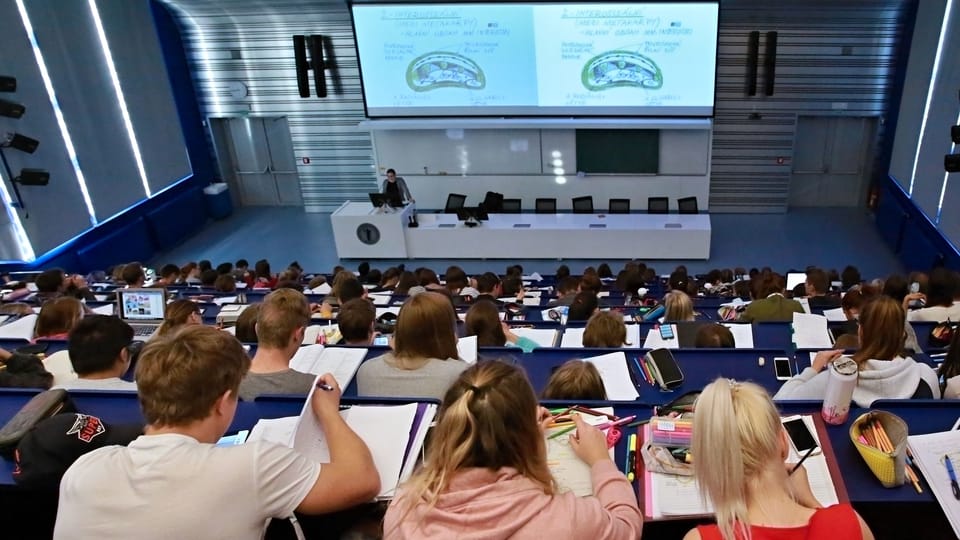
"I sometimes say that we are more important for Ústí than Charles University is for Prague," he says. "If Charles University disappeared, Prague would still be Prague. But if we disappeared, it would be a nightmare for the city."
Beyond teaching, the university conducts research, cooperates with local businesses and public institutions, and helps retain young talent in a region that has often struggled to keep graduates from leaving.
Listening to Koutský, one gets the sense that Czechia's regional story is far from finished. While geography and history still shape opportunities, today's universities, infrastructure and local leadership may prove just as important in determining which regions thrive in the decades ahead.
The complete interview with Jaroslav Koutský is available in the latest episode of Czechast on all major podcast platforms and on the Radio Prague International website.
Related
-

-

Discover Czechia's regions
With its rich history, stunning architecture and beautiful skyline Prague attracts visitors from all over the world. But there is much more to see in Czechia.
about programme

Czechast, Radio Prague International
Czechast is a regular RPI podcast about Czech and Moravian culture, history, and economy.