“I’m interested in the female experience”: Photographer Bet Orten on art, motherhood and moving on from fashion

Bet Orten studied fashion photography in London after a stint as an assistant to a well-known celebrity photographer in New York. But for the last decade and a half Orten, whose Instagram profile describes her as a “female photographer taking pictures of other females”, has been living here in her native Prague. We spoke at our studios ahead of an exhibition she has coming up in the Czech capital this spring.
Where does the name Bet Orten come from?
“There’s sort of a story behind that. My original first name is Alžběta, which in English would translate as Elizabeth.
“Jiří Orten, the famous Czech poet, was the cousin of my grandfather.”
“When I moved abroad and started to study in London it didn’t seem to me quite appropriate that people would call me Elizabeth.
“So I just decided to make this short version of it. In American English it would probably be Betty, which some people used to call me when I travelled to the States, but I really didn’t like that.
“Then the British way would be Beth, and I didn’t like that, either. So then Bet – that was it. I still love it; it’s my favourite version of my name.

“As for Orten, Jiří Orten, the famous Czech poet, was the cousin of my grandfather. The original family name was Ohrenstein and he also went for a kind of nickname, for his poems.
“I really love that – and I really took it as my own.”
What was it that first brought you to the whole world of photography?
“I started very young, actually. I think I was only about 12 years old when I first found this very old camera – it was probably 35mm, analogue, I don’t even know what brand it was.
“It was in our house, somewhere hidden in some closet, and was probably my grandfather’s camera. I was fascinated by the object.
“Somebody explained to me how it worked and that I’d probably need to buy film. So I bought some black and white film and just did it – but there was nothing on the film; the camera was just broken, I guess.
“But I loved the process, very much. I actually remember nearly every second of taking pictures on that camera. I was just fascinated by that.
“And then I waited. You would probably wait for a week for the film to be processed. And I even loved that, the waiting part.

“And I was, like, OK, this is very interesting [laughs].”
At what point did you start feeling you had a talent for it? Or at least feel that it was the area for you?
“I started to take pictures. My mother bought me my first camera, analogue. And I just started to take pictures, to buy film. I had a little darkroom in our house and so on.
“And then I did sort of like a tiny exhibition in front of the principal’s office, in the hallway at our school.
“The teacher said, I think we see a developing talent here. I was, like, Yeah, I feel that too.”
“We had this teacher for art history. This was still elementary school. And it was really like a vernissage – it was probably connected with something else as well, but my pictures were in the hallway.
“And the teacher said something like, I think we see a developing talent here.
“In that moment I was, like, Yeah, I feel that too [laughs].”
It’s always great to have someone like that to encourage you at the right age.
“Absolutely. And I felt horrible in all other subjects, and everything; I always had very bad grades and was doing all the bad stuff everyone shouldn’t do and so on.
“So she really empowered me in that sense.”
Who are the photographers who you most admire? Or are there any who you feel influenced by?
“It’s more like I’m not only influenced by the photographs that they create – sometimes it’s more the story that comes with the person, their life, the way they handled themselves on the way to becoming great photographers.
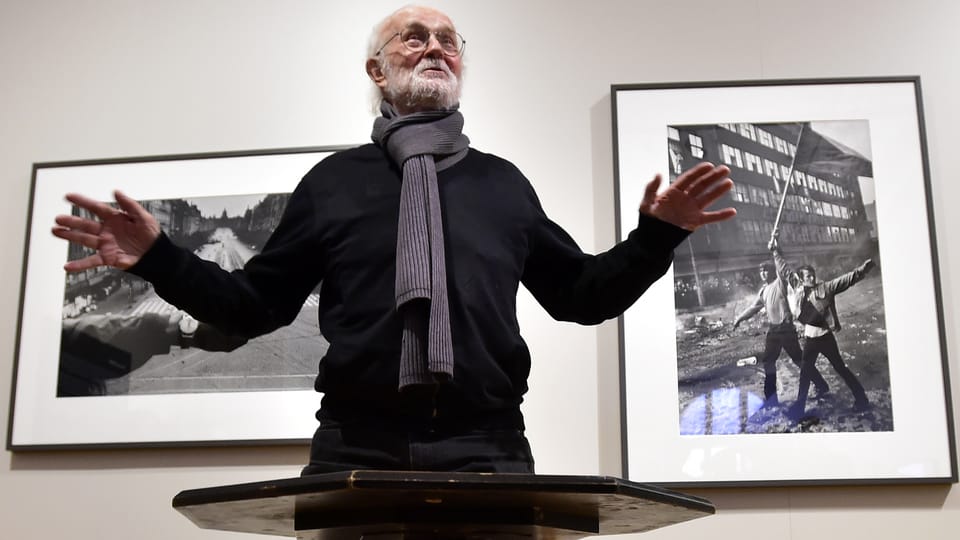
“Probably that would be Nan Goldin, an American photographer. Sally Mann, also an American. And then of course some of the great Czech names, like Josef Koudelka or Libuše Jarcovjáková, who I admire very much.”
I know you did some work experience in New York and also studied in London. Which of those came first?
“New York was first. It was a total coincidence, actually. I was called from film production, who asked if I was free in some particular week.
“They were looking for someone for the position of local assistant. They knew I had good English so they called me for a photo shoot, to assist an American photographer.
“I spent a week working with this big American team and was very fascinated by that. So I asked, Guys, if I come to New York, can I work for you?
“And they said, Yeah, of course. We won’t give you any money, we won’t give you any food (or not very often), you will work hard, even weekends – are you still in?
“And I said, Yeah, totally [laughs].
“Then I flew there in, I think, September and I stayed about six months.”
You worked with Steven Klein, who is or was known for his work with major stars. Did you get much of a view into that world of celebrities?
“Yes. We shot Bono Vox, Damien Hirst, many American actresses.
“I was really hoping to see Madonna, but then they actually flew to London and didn’t take me with them, unfortunately.”
And he worked with Madonna repeatedly?
“Many times. So I really hoped I’d see her.
“Also there were other not so famous names but they were stars within the fashion world.

“So I got to meet Grace Coddington, who was the fashion editor for American Vogue, this really amazing woman, and I had my 10 minutes with her: we had a little chat, we exchanged some jokes and I’m still quite amazed I could have, you know, lived that [laughs].”
So I guess after that you studied in London? You were there for several years?
“Yes. It was still in New York when I realised my favourite areas would be tiny little cafés hidden in somewhere like Greenwich Village, or even more in Brooklyn and places like this.
“I was, like, I guess these are more places that remind me of Europe. And I realised my heart is so European – and I just needed to go back.
“Back then I thought I would not be able to live in Prague and London was always the place I wanted to go. It was my major dream since I was quite little actually, since the first time I visited London.
“I found that one of colleges of the University of the Arts was the London College of Fashion and had a Master’s programme which was fashion photography, so I applied and obviously travelled there for the exams.
“And they accepted me.”
When you say that you couldn’t see yourself living in Prague, how come you ended up living in Prague?
“That’s a good question [laughs]. I ask myself sometimes, but of course I know the answer.
“So it was the second year of my Master’s when I found out that I was pregnant.

“That was sort of a turning point in my life, obviously, and I still stayed in London for a couple of months after that, but then realised there was no way… because I was alone, the partner wasn’t present, and my mum, and my family in general, helped me big time.
“Going back home was the option. Then I met my life partner, who is my husband now – and I stayed.”
How did having children – you now have two children – affect your work? Or did it affect your work?
“Oh massively, yeah. First of all, I think giving birth to my first child, my son – I have a son and a daughter – changed me a lot.
“Then becoming a mother and having all that experience, which is just life-changing of course in many senses – we would be here for a long time if we just discussed motherhood.
“I think it really changed me in the sense of being more humble towards life and not really fighting with it; sometimes just going with the flow.
“I’m extremely happy where I am right now.”
As for your work though, did it mean it was harder to do projects? Or were you able to achieve maybe a bit less than you might have wanted to at that time?
“Of course. Of course. That bit was extremely hard for me, and I must admit I did struggle with that part for some time, because there was still a bit of the artist’s ego that wanted more and felt sorry about all the opportunities I was missing out on; the fact I could not be in London anymore and I couldn’t do particular jobs and so on.
“Something you don’t want to hear when you’re 25, my age when I had my first child, is the word ‘patience’.”
“But seeing it from the perspective of a 40-year-old woman now and all motherhood brought me – I also have a daughter now, which also changed my perspective on many things – I think I was just supposed to wait.
“Something you don’t want to hear when you’re 25, which was my age when I had my first child, is the word ‘patience’. You just hate it, or I used to hate it [laughs].”
What’s the main focus of your work? You do commissions and fashion photography, is that correct?
“Not really, actually. I sort of left fashion photography, even though I love it still and I believe it’s the subject of art photography, which you can see mainly abroad. We mentioned Steven Klein, and he’s really an artist.
“But over time the actual fashion was really bothering me more and more in the pictures, so I started to create my own costumes or I collaborated with costume designers and we created costumes together. So it’s not a particular fashion.

“And yes, I do get to do some commissions from time to time, but very rarely. It really has to be either a brand or a designer or someone I have a connection with and we like working together.
“Then it’s mainly my own projects – and my main focus is women.”
Your Instagram profile says you’re a “female photographer taking pictures of other females”. Why did that become such an important part of your work?
“I guess because I’m really into the female experience. There is so much I still want to explore, and ask. I want to see how other women live.
“I have so many questions around that. How to deal with life if you want to be a mother, if you don’t want to be a mother.”
So is it kind of a way for you to spend time with interesting women?
“As well, I guess. It’s also because I have a new studio now, where I want to invite as many women as I can.
“Over time the actual fashion was really bothering me more and more in the pictures.”
“My shoots, or sometimes it’s just a portrait, start with an interview. So yes, it’s probably that I’m really interested in them.
“Not that I wouldn’t be interested in men, but I feel the last centuries were all about men, so I do feel I need to question women more [laughs].”
How is it different if a women photographs a woman than if a man photographs a woman?
“I will answer this in my PhD one day [laughs], because I’ve come to find out that the answer is so complex.
“I’m really into digging deeper and I think it will be a PhD thesis.”
Maybe you could comment on one thing. I’ve seen you saying in the past that you have the impression that women take photographs of other women “for men”.
“Back in the day, let’s say the 1990s or early 2000s, it was still very much a male environment.
“And in this male environment to have your work get attention, or be respected by men, you could either go to war and become a war photographer – and some do that.
“But then if you take pictures of women, you objectify them. You take off their clothes. You show their naked bodies. But you show them with this male gaze kind of perspective.
“Unless you love women, if you’re a lesbian… I can’t see myself taking pictures of women in this particular way.”
I must say I hate nude photography. I think it’s old-fashioned. It reminds me of something from the 1970s, or maybe the 1930s or whenever – but why are people doing it today?
“When you asked me about my favourite photographers, there’s one, who’s also American, called Ryan McGinley; I really love his work, I adore it.
“I took some pictures of naked women – and I just hated it.”
“He also did a bit of fashion, but his beginnings were in skateboarding and that kind of scene, though he’s gay.
“He started to take pictures of his friends – guys, girls – in the wild, in nature. And they were always naked but it was never objectified.
“There is a naked body of human being and it’s like part of the environment, part of nature. But it was never obscene, or even sexualised.
“I really recommend seeing this, because it really changed my perspective on nudes.
“But otherwise, when I was doing exams to get to FAMU you have three exams to do, and one of them is nude photography.
“Of course it can be men as well, but I wouldn’t really understand why.
“So yeah, I took some pictures of naked women – and I just hated it and I didn’t understand why [laughs].”
Getting away from gender, what makes somebody photogenic? Can you see somebody on the street or on the tram and say they’re photogenic? Or do you need to look through a lens?
“You need to look through a lens – or I need to.
“But I also study people’s faces if I travel on transport in cities. Sometimes I probably stare at people even.
“I’m just fascinated. I’m also fascinated by the ‘photogenic-ness’ of people.
“And when I don’t know someone and they’re in front of my camera for the first time it takes a bit of time for me, because I need to see the face or the body from certain angles.
“I’m 100 percent sure that everybody is photogenic, it’s just that some people only have one angle where, all of a sudden, it all kind of fits.
“And models have, like, 50 angles [laughs].”
But is there something about simplicity of face that’s connected to being photogenic? I read about an experiment where they took, I don’t know, 500 photos of people considered good-looking and made a composite photo from them – and the resulting picture was essentially a picture of a baby: somebody with big eyes, a clear face, symmetrical. I wonder if that is connected with being photogenic.
“Probably. It’s bigger eyes, bigger lips, a certain shape of face where you see more of the bones.
“What I’m searching more for in a picture is the character of the person, so that’s what I follow and it’s not, of course, some random beauty.

“But what I’ve learned, which is very interesting, is that if someone has a really big nose, let’s say, or tight lips, then the photography actually makes it even worse [laughs], so that’s one thing to deal with.
“But again, I think everybody can be beautiful.”
Obviously technology is moving very fast. Many people in many fields are worried about what it’s doing to their area of work. Are there any ways in which you feel photography is in some way threatened by technology?
“You know, there are many discussions on this topic right now.
“But me personally, I’m not threatened at all.
“Part of what I do and the way that I do it is the actual process of taking the picture. It’s not only about the outcome.
“It’s sort of like a performance, not that I would need to perform in front of someone, but for me and for my team we always want to enjoy it, and we’re always a bit on the edge: because of the weather and other circumstances.
“And even the photographed people actually really like that. And this is something you will take from them if I can say, OK, use AI to do some nice portrait.
“But how boring is that? You can be in the wild nature and be standing on rocks, the wind in your face – that’s an experience.”
You teach. What is the main thing that you want to communicate to your students?
“What I see is that people who already went through some photography experiences tend to follow certain rules, and they’re very much afraid to break the rules.
“But then you can’t really be free, and really create.
“So what I see as my major work in that sense is to tell them, OK, forget everything you’ve learned. I mean it’s fine, the technical aspect is important, but first of all, find some subject that you will just love and you will want to follow – and then the rest will come and just follow that.
“I tell them to forget about composition, rules and all that.
“So it’s probably this.”
You have an exhibition coming up, is that the case?
“Yes, my exhibition is coming this spring. I’m very much in the whole preparation process now.
“And yeah, I can’t wait to invite my fans and whoever likes my work, and even the ones that don’t know my work yet, to come.”
Where is it going to be?
“It’s going to be at Chemistry Gallery, in Holešovice.”
Related
-

-

Prague Talk - EP59: Libuše Jarcovjáková
Photographer Libuše Jarcovjáková documented her own turbulent life, and minorities such as homosexuals and Romanies, in the final decades of communism in Czechoslovakia.
-

Photographer Josef Koudelka: “I don’t believe in inspiration”
Josef Koudelka is one of the greatest Czech photographers of all time. In Prague recently he discussed a major donation to the state, and much more.