UNESCO mission recommends reconstruction of Prague’s iconic Vyšehrad Railway Bridge

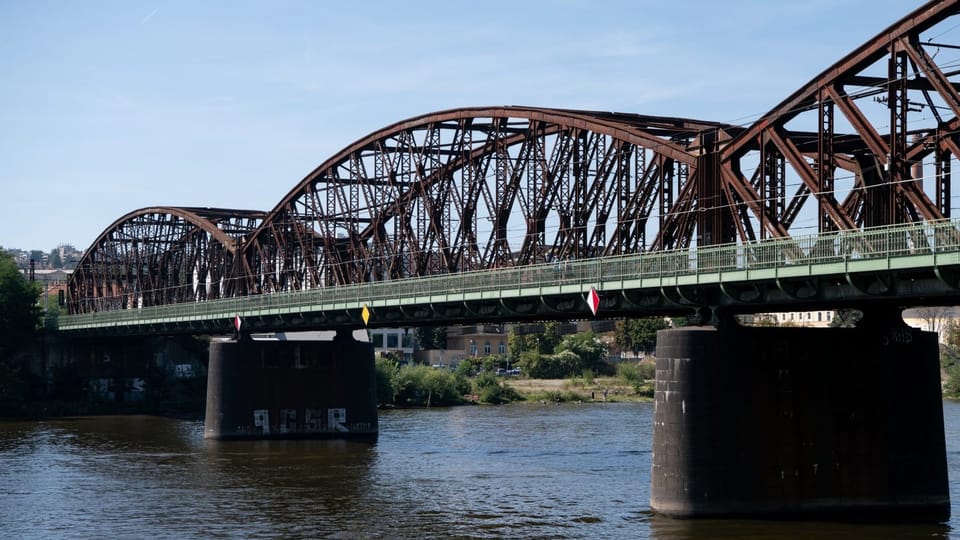
In response to the Czech Railway Administration’s proposal to replace the famous railway bridge over the Vltava at Vyšehrad, an advisory mission of the UNESCO World Heritage Centre and the International Council on Monuments and Sites visited Prague last December to review the plans themselves. Their report, now published and submitted to the Ministry of Culture, has instead recommended the reconstruction of the listed bridge.
To understand the importance of the Vyšehrad Railway Bridge and the view of those seeking to save it, Danny Bate spoke to the British structural engineer and bridge designer Ian Firth.
You were previously involved another report about the Vyšehrad bridge. What were your recommendations and conclusions in that report?
“We've always been looking at the bridge from the point of view of restoring it and keeping it. Our raison d'être, our approach to the whole project, delivered largely by our client, was to say, ‘Look, here's a piece of history that surely is worth preserving. So can we have a look at it with that in mind?’.
It seemed to us that those who had looked at it previously had rather quickly dismissed it as being unsaveable
“It seemed to us that those who had looked at it previously had rather quickly dismissed it as being unsaveable. We inspected the bridge, many years ago now, and yes, it's corroded and it's got some issues that you would expect of any bridge that has not been properly maintained. But it's not falling down.
“A lot of my work over many years has been assessing existing bridge structures, seeing how they can be retained, restored, strengthened, rehabilitated, to give them a new lease of life. So that was my starting point. We did our initial brief, and we had a very short commission to do a little piece of work, and our initial analysis showed us that there’s a very good chance of it being saveable.
“Then, of course, there was the point about the third track. We worked with an architect, a friend of mine I've worked with for many years, to come up with a design for a third track. At that stage, we were looking at things on the north side, partly because of the way we were looking at the station arrangement at Vyšehrad and Výtoň. That then led to an initial report, which said that the bridge could be saved, that it'll need some work, but that we can build a new bridge alongside it, which will not detract from, destroy or damage its historical and social value. That must have been six or seven years ago, certainly quite a while.”
And do I understand it right that your summary of the situation was that to keep the present bridge would in fact be cheaper?

“Yes, my assessment is that it would be, but the big reason for keeping the bridge, and for doing it in the way that we are proposing, is that you maintain railway traffic throughout. The cost of the disruption from losing a railway crossing over the river there for any extended period of time is enormous.
“What the railway company was proposing to do was to knock down the existing bridge and build a new one. That would mean losing the service of the railway for, in my mind, a couple of years at least. You can imagine that what that does to railway traffic, and the cost of all of that. That is what will swamp the cost of that proposal.
“In what we're proposing, there are two ways to do it. You either repair it in what we call ‘in line’, where you will have restrictions, certainly only running one track at a time and possibly not even that for some periods. But what we really recommend is that we take away a span over a weekend and replace it with a temporary span. So, you lose service for a weekend, but then you have full service while the span that you've removed is fully restored, repaired and upgraded and made to look almost as good as new, with a new lease of life for another hundred and twenty years or so. Then you come and put it back, and you replace the next span. So you lose service for a short period three times, but you've maintained railway service throughout.
This is the approach that is required if you're not going to have railway chaos
“That is our strong recommendation. We've done that kind of thing before; it's actually a very common practice to do things that way, moving very large objects and dealing with them off-site. We often build our bridges that way. We build the entire bridge to one side and then bring it in on floating pontoons. We think really that this is the approach that is required if you're not going to have railway chaos, transport chaos even, in Prague for a matter of years. Nobody wants that.”
Besides the practical arguments that you've laid out, there is something special about this bridge as a monument. Prague has other famous bridges – there is one that comes to mind slightly downriver from the Vyšehrad Railway Bridge! What then in your mind is special about this particular bridge?
“It is interesting, isn't it? On face of it, somebody might look at it and say, ‘It's a rusty old steel truss bridge’. But first of all, it sits in front of Vyšehrad. You've got the views of the castle and church. It appears in images of the city.
“There's something about its industrial aesthetic that speaks of what we in the UK would call ‘Victorian’ enterprise and development, the great era of growth of the city, of great wealth and prosperity. Of course it speaks loudly of the railway heritage, the growth of the railway, which was so critical.
“So I think it has a very important social, cultural, historical identity. That comes across in the UNESCO report. You'd expect them to say that; you'd expect them to be keen to maintain it. I have to say I'm very pleased that the report is stronger than I thought it might be. It's no surprise that UNESCO would prefer to keep the bridge, but they have highlighted why it's of such significance to the universal value of the city.
In Prague, there are two bridges which are iconic. This one and, of course, Charles Bridge
“It is one of those things that people probably either love or hate. But you could say the same thing actually about Tower Bridge in London, which is a pain in the neck from an operational maintenance point of view. It's an absolutely disastrous thing to have to maintain. But can you imagine London without that bridge? It's iconic. I don't use the word iconic freely, I use it very rarely. In Prague, there are two bridges that are iconic. This one and, of course, Charles Bridge. You couldn't conceive of taking them away, because the city would lose part of its identity.”
The two bridges of the city represent two faces of the city, in two different periods then. So, with your report and now the UNESCO report, are you hopeful for the future of the bridge?
“I'm always hopeful. But I'm also a realist and a pragmatist. I know that there are all sorts of constraints. There'll be economic ones, there'll be political ones.
“I can imagine that the railway authority will still want to fight their corner. I can see where they're coming from; I know the arguments that they're using. They may well still try to persuade ministers and the powers-that-be, to allow them to proceed with their plan.
“But I am much more hopeful now that they won't do that, or they won't be allowed to do that. What concerns me is the time that's ticking. As I said to you at the beginning, I've been involved with this bridge now for several years, and it's not getting any better. The corrosion continues. It is in pretty bad shape, thanks to the lack of maintenance for over sixty years. Zero maintenance, as far as I know.
“It is absolutely no surprise to me that the bridge is in the state that it's in. It's completely irresponsible of those who should have been maintaining it, who have allowed it to get to that state. People have argued, ‘But you can't give it a new lease of life that will give it another hundred years’. Yes, you can, but it will require whoever is going to look after it to look after it! That means inspecting it, maintaining it, painting it from time to time, and so on. It hasn't had that tender loving care for decades.
“So, I'm hopeful that it will get done, and I'm hopeful it will get done quickly, because, unfortunately, it's a problem waiting to happen.”