Prague Castle research reveals hidden wilderness
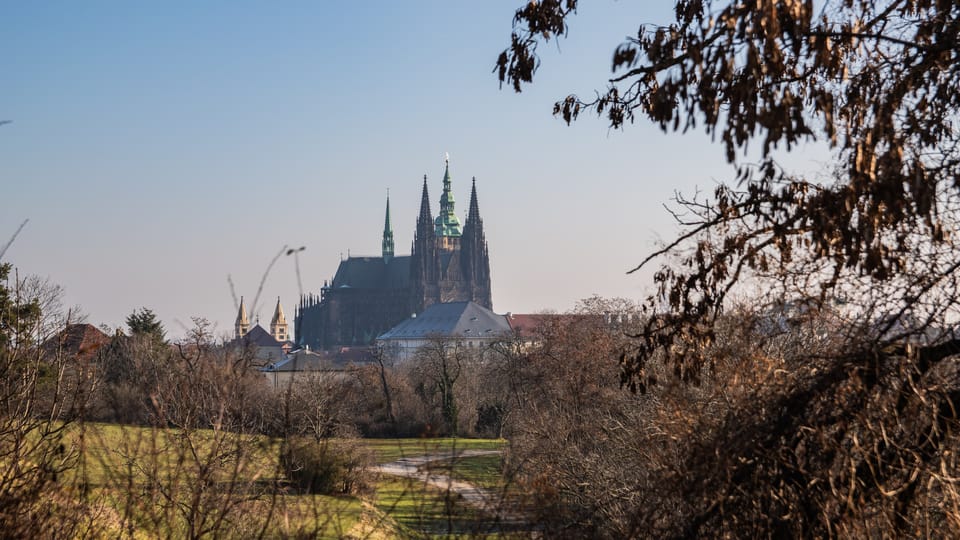
More than forty species of birds, over two hundred species of insects and hundreds of plants. A new biological survey shows that the grounds of Prague Castle are not only a historic landmark but also a surprisingly rich ecosystem. Researchers even discovered soil mites never before recorded in Czechia. I spoke with soil biologist and ecologist Ladislav Miko, who also serves as the Czech president’s adviser on environmental protection and sustainability, about what the team found during the survey at Prague Castle and why such biodiversity has been preserved there.
What was the main aim of the research carried out at Prague Castle, and why did scientists consider it important to study the biodiversity there?

"I think that the demand to do it came from Prague Castle itself. Prague Castle, as probably many people know, is the largest castle area, certainly in Europe. There are parts that are green spots on the map of Prague which belong to Prague Castle and which have apparently not been intact, but still natural or semi-natural, for centuries.
"The question of what is actually the biological value of these territories was obvious, but until now nobody had really studied these places. The Office of Prague Castle invited scientists from Prague, from Charles University, to check them because they are preparing a management plan for these territories.
"They wanted to have a management plan that will not endanger potentially valuable biodiversity which may be present there."

How extensive was the research? How long did it take, and what kinds of experts were involved?
"It was actually a group of experts, I think around ten people. The research started very early in 2025 and was carried out across the whole season until late autumn, which meant basically plenty of individual visits by researchers.

"My participation was relatively minor. I’m a soil biologist, and I was looking at what is living in the soil. For that, you come and take soil samples and then extract the animals in the lab and study them there.
"So you don’t really need to be present in the same way as colleagues observing birds, who need to be at the place, looking around and listening to what is there. For entomologists or soil biologists, it is a bit easier."
The survey recorded dozens of bird species, hundreds of insects, and more than 700 plant species. Which of these findings do you consider the most significant?

"I think the most significant is actually the numbers you mentioned, the very high diversity. In the end, we are speaking about a territory that is only several tens of hectares altogether, so it is actually a very small area.
"Such a high number of birds and plant species is remarkable. Even if you know that you are in places where plenty of trees and plants have been planted over the centuries, still 700 is really a very high number.

"From my perspective, the biggest surprise was probably the soil fauna, because I was expecting species that are common in urban parks or something similar. But surprisingly we found quite a number of rare species, which attracted the interest of the media and many people.
"Three species found there were recorded for the first time in the Czech Republic, and on top of that I also found one species which is even unknown to science. That means we will have to find more individuals and describe it as a new species which could, for example, get a name after the castle."
Is it true that the area around the Deer Moat preserves traces of steppe and forest-steppe habitats that go back to the Ice Age?

"Indeed, in Central Europe we have the concept of so-called mammoth steppes, which are cold steppes that predominated in the Czech landscape just after the retreat of the glaciers after the Ice Age.
"They are defined as semi-steppe or steppe habitats with cold winters but very hot summers, and they support a specific fauna. There are some small islands of remnants of that fauna which can still be found in several places in Central Europe.
"The species which I mentioned in the soil, for example, indicate that most probably this territory was actually part of this larger habitat, which now remains only in very small and isolated spots."

The report also mentioned a kind of wild tulip described as a flagship species of Prague Castle. What makes it so special?
"This is a species which is normally not a member of our flora and which in medieval times was used as a decorative plant in gardens.

"But unlike most plants used for decorative purposes, it is actually a wild species which is able to escape from gardens and start using the habitat as if it were a natural original species. We have a wild population of this forest tulip in the territory of Prague Castle, so that is obviously very interesting.
"The issue of new species coming to our territory is very relevant recently because of invasive alien species which are basically dominating our flora and degrading our biodiversity.
"This is a historical record of a species which is not native to our territory but could survive. Fortunately it does not have an invasive character. It is not destroying the original flora, but it is just contributing to it."
Why do you think the area around Prague Castle has managed to preserve such a rich ecosystem? Could it be partly because some areas have long been inaccessible to the public?
"Almost surely yes, but it is not only that. It was always part of the defensive architecture of Prague Castle, so it was not allowed to be built up, and this is the most important element.
“Over the centuries small patches of steppe, forest-steppe, and forested areas remained in a place which, in the centre of a large city, would normally be built up.”
"Over the centuries small patches of steppe, forest-steppe, and forested areas remained in a place which, in the centre of a large city, would normally be built up. Because it was the defensive area of Prague Castle, it was left with original or semi-original vegetation, including the flora and fauna which belong there.
"During the communist regime it was also totally inaccessible and it was not managed very much. Even the use of chemicals or harsh management methods used in parks were not applied here, and that preserved the very rich flora and fauna in this area."
Now that we know how rich the ecosystem at Prague Castle is, what should be done in the future to protect it?
"It’s a great question because the easiest answer is actually just let it be.
“We actually told the managers of Prague Castle: just let it be, please. Just leave it to continue existing as it has been for roughly 1,500 years."
"There are areas which would require a little bit of management, for example making sure that the steppe areas are not overgrown by the succession of woody plants.
"But generally speaking we were actually telling the managers of Prague Castle: just let it be, please. Don’t really manage it, don’t try to make it nicer, don’t cut it down to have a nice lawn or something similar.
"Just leave it to continue existing as it has been for roughly 1,500 years."
Related
-

Military ground of Libavá turns into sanctuary for rare bird species
Despite the sound of gunfire, explosions and ground army vehicles, the military ground of Libavá has become something of a sanctuary for rare species of birds.










