Police vs. ravers: Šimon Šafránek on how CzechTek culminated in violence

CzechTek was a free techno music festival that drew many tens of thousands and culminated two decades ago in clashes between riot police and participants. The annual unauthorised gathering and the culture that spawned it are the subject of a new podcast by Šimon Šafránek, CzechTek: The Story of Czech Rave. I discussed the background to, and fallout of, the events of 2005 and much more with Šafránek, a successful documentary filmmaker whose work regularly explores alternative culture.
What’s your background? You’re a journalist by profession? How did you get into journalism, specifically arts journalism?

“It was a kind of by chance really. I think it’s, like, I don’t know, 25 years ago, maybe longer.
“I was offered to run this web magazine for cinema. But still it was more like a job for me.
“I wanted to make movies and that was kind of difficult. And then we did a documentary on Nick Cave fans.
“And then I lived in Berlin, and then I came back [laughs].
“And then I worked at a magazine, which was actually fun because before that I would kind of dread to do interviews; I didn’t want to speak to people.
“I used to go to free parties 25 years ago.”
“But then I was doing interviews and I kind of started to like it really. It was fun to go to the Cannes film festival and such.
“But still I wanted to make movies. And then I kind of found a way with documentaries, like King Skate, which played really well here.

“And then we made this portrait of Miro Žbirka, called Meky, and so on.
“So now basically journalism is just a hobby for me really, also with the change of the landscape, economically.
“So now I just go to the Cannes film festival and that’s it basically [laughs].”
As a filmmaker are you kind of self-taught? Or did you study?
“I’m more self-taught really. I think I applied for FAMU [film school] two times and never made it through the process.
“And then there was this time where I started to go more often to Berlin and lived there a lot, so it was kind of too late to go to school.
“I think it’s great if you can go to school, but I just didn’t.”
You eventually even won a Czech Lion for King Skate, which is about skateboarders here in Czechoslovakia under communism. What was the appeal for you of this subject, this community of skaters here in the ‘70s and ‘80s?
“There was this book called Prkýnka na maso jsme uřízli. It’s like an oral history of it.

“When I saw the photos there they were amazing and I thought, Wow, if there was any footage, like video or film, that would make for a great film, I think.
“And it was there, so that was great. Also I think there was a huge contribution from my editor, Šimon Hájek, who did a great job there.
“He was a skater too, so sometimes he would just say, Hey, this is interesting, this is maybe not so interesting.
“But yes, the whole thing was interesting, exotic in a way really.
“And I have great memories of that time when we did that movie.”
You’ve also worked on projects about for instance Czech rap. I guess one of your biggest films has Meky, about the Slovak pop singer Miroslav Žbirka. Unlike a lot of your subjects, he was not in any way underground. What was the attraction of Miroslav Žbirka as a subject?
“But we made it a little bit in that way [laughs].

“There was a certain time in his career, in the ‘80s, when he had this band called Limit with Laco Lučenič.
“They made three like new wave records with really modern sounds, for that time, and a little bit depressing lyrics. Or they weren’t these, like, ‘happy socialism’ or whatever records.
“And I knew a couple of them and we used one or two of these songs in King Skate, because it went really well with the kind of punk rock, electroclash-y sound of the soundtrack.
“So it was a great opportunity to put this story into a film.”
Now I believe you’re working on a film about the great Czech artist Krištof Kintera. How has it been working on this film about Krištof?

“It’s crazy, but it’s lovely [laughs]. It’s really great, it’s interesting. I think we work closely.
“Also there is a different approach, because it’s not like King Skate or Meky…”
It’s not archive stuff.
“Yes, even with Rap Story there were a lot of archives. This is less so, and it’s more about the creative process, it’s more about creation itself: What do we want to say with a picture?
“But yes, it’s really interesting. And let’s just see.”
I don’t know Krištof very well but I do know that he has a unique perspective on the world; he really sees things in a unique way, it seems to me.
“Yes, that’s true. I think he has a great sense of humour, which we want to put in there.
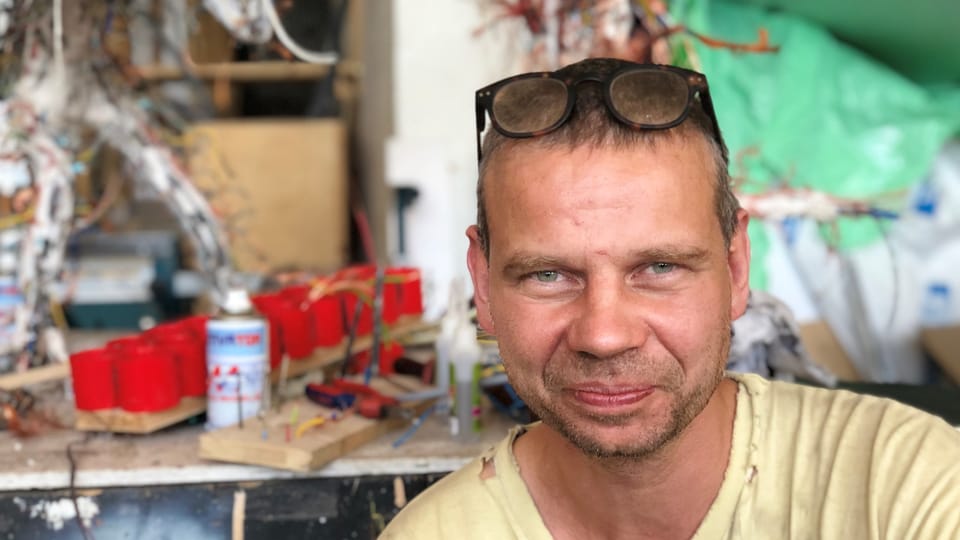
“The thing is, it’s not a classical documentary portrait, like, Hello, I’m Krištof and I do art.
“C’mon – I’m not interested in that all.
“Basically at first he didn’t want to be in the picture, like physically. Now it’s changing, but it’s a really a kind of dialogue with his art and the art talking back.
“It’s still like super alive, so it’s a little bit hard for me to talk about it, because everything is changing.
“It’s actually funny, because his company is called Všechno je jinak, Everything is Different, which is kind of synonymous to the film in a way [laughs]. In a good way, I hope.”
The reason I wanted to speak to you right now is that you have a new podcast out called CzechTek for Czech Radio station Vltava, about the famous free techno event that was held annually in the Czech countryside from 1994 onwards. What was it that made you think that CzechTek would be a good topic to explore?
“It’s a subject that’s very close to my heart. I used to go to free parties, like 25 years ago or something; it’s crazy to say that [laughs].
“And then I wrote a book, a kind of road movie type of book called 23, which was based on my memories, my experiences.

“It was the story of fictitious group of people, who could be a sound system, travelling around Europe. And I loved that lifestyle.
“I was actually thinking of making a kind of documentary or film, some kind of essay, I don’t know. But there was this television documentary from Rozálie Kohoutová, CzechTek, six or seven years ago.
“So I thought it would be very interesting, and also a challenge, to do it as a podcast, not like just people talking but really using the imagination of audio, of sound effects and music, to put it all together and make it the story of Czech rave.
“Its roots were in 1994, when there was the first free festival. There were these English sound systems that came to Czech, namely Mutoid Waste Company, with Joe Rush, who started these parties in England, in London.
“He was working on films, on set design. It was really funny, he was telling me this and I said, What films did you work on?
“And he said, Alien, Star Wars, Dune. And I was like, Oh yeah!”

It makes sense, right, if you think about what they made: these enormous kind of post-apocalyptic works from huge pieces of metal and God knows what.
“Yes. And then there was no use for it after the shoot. So he was thinking it would be great to put parties into this environment.
“So he did that and then they had to leave England.”
The law changed, right? Prior to your podcast I hadn’t heard the term “repetitive beats” for years. It was part of legislation in the mid-90s that basically forced this traveller/rave culture out of the UK and into mainland Europe.
“[Sound systems] came to Czech in ’94, with this huge convoy of Russian fighter jets.”
“Yes. And they basically colonised Europe with this style of techno music and this lifestyle – the travellers’ lifestyle.
“They came to Czech in ’94, with this huge convoy of Russian fighter jets.”
That was also an amazing detail, about these MiG planes. A few years earlier the Russians had been kicked out of Czechoslovakia and now these planes are coming back and ending up in this airfield in Hostomice, where the first edition of CzechTek was held.
“Yes. It’s crazy. I think this Mad Max element to it is really interesting, visually. I really love that.
“So it was just great to talk to this guy, you know.”
Also one thing that I didn’t know anything about, and you find out in the podcast, is that this whole scene in this country started in a way from Obecní dům, where there were these bars run by Westerners; some of the staff were involved in spreading the word about the first big free festivals.
“Yes. I think the expat community in the early or mid ‘90s was really influential, culturally. Of course, because they were bringing in trends and things that just weren’t here.
“Here in ’94, ’93, there was no internet.”
The classic thing was you had to make a phone call. You’d drive around call some number from a petrol station, to find out where the venue was.
“The expat community in the ‘90s was really influential, culturally. They were bringing in trends that just weren’t here.”
“Yes, the logistics of it was that there was an answering machine and there a short message. You had to call that number and then you would know either where it was or at least the general area.
“I remember those parties in the late ‘90s where we would to the countryside, to some forest, and you would just kill the engine and listen…”
"Where are the beats?"
“Where are the beats or some music or some lights or whatever. And you would just drive around like that, because there were no phones.”
How big did CzechTek, which I guess was every year, get at its peak?
“I think at its peak it was 20 to 40 thousand people.

“I think basically kind of followed the same wave as in the UK, which this party at Castlemorton [in 1992], which was basically the same, with around 20 or 30 thousand people.
“It was meant to be much smaller and then it got out of hand – and then there repercussions from the state.
“And here it was basically the same, with the twist that the government [during the last ‘original’ CzechTek in 2005] was a leftist government [led by the Social Democrats of PM Jiří Paroubek], which was crazy – that a leftist government would kill the party.”
Prior to the most famous CzechTek, in 2005, how did people in these country places – let’s say in the ‘90s – view these trucks coming in full of young people and the noise and I presume the dirt?
“Well I think it would be the same as anyplace else.
“Because when I read about Castlemorton there were the people who lived there, and they would be angry at the ravers, they would be angry at the police for doing nothing and they would call their members of Parliament.
“And here it I think it was the same. Some people would be angry that they couldn’t sleep, some people would be amazed.

“I think that there was really strong negative coverage by the media. It worked like clickbait, I guess, in today’s terms, so they really pushed that image of noise, dirt, drugs and lawlessness.
“The really interesting thing, and the guys also talk about it in the podcast, is that when the scene is smaller there’s such a difference when you come to a free party: nobody controls because people are friendly, people help each other – and it’s a feeling of super freedom, liberty.”
It sounds almost utopian.
“It is. It is, of course. And of course then, as it attracts more and more people, this like anonymity of the crowd kicks in from the other side and bad stuff happens.”
For people who don’t know, what happened in 2005? For most people if they think of the name CzechTek, they think of that edition, which was the last one, at least in the original spirit.
“It started to grow really big, after the turn of the century.

“Even in Prague when there were smaller parties you’d go one week and there were 200 people, you’d go the next week and there would be 400 people and it would just explode.
“It was the same for CzechTek. It grew exponentially. I think since 2003 there was news coverage, on radio, on television and everywhere.
“There would be reporters from Nova TV and whatever. And it was just too much.”
You say it was too much. But still the police didn’t necessarily have to intervene like they did, the government didn’t have to react like they did.
“Yes, there was this government that basically took it as a mission.
“It was a mission for them to go against the ravers. It was probably an easy target for them, because they were different.

“I think the aggression kind of built up too. Because before 2005 there was already, I think in 2004, some bigger party that was cancelled by the police, a little bit violently, so to speak.
“And those were the orders, to kill it, so they killed it.”
Was it the case that this kind of confrontation between the police and young people hadn’t happened like that since before 1990? Because the police in the 1990s kind of kept their heads down and wanted to shake off their reputation from the communist days.
“Yes, that was the image. And when you really had this image of the police in full riot gear standing against kids and girls and dancers and ravers, I think that most ordinary people would see the same…”
It looked like earlier in 1989?
“Yes, the memories were there. Then there were these protests in Prague.”
Which even Havel attended.

“Yes. Of course it became a political issue and the right wing parties said it was unacceptable, which it was.
“Ultimately I think it cost them the elections. The left wing party lost the elections also because of this; there was such a strong display of force against youth.
“And it was the first one of this size since 1989. Of course there were evictions of squats on stuff, but that was on a smaller scale. This was huge.”
You obviously did a lot of research, working on this project. Even for somebody who was there, was there anything you feel like you learned about the whole rave culture here in this country?
“I think what was really interesting was to compare the ‘90s with today especially in regard of freedom. What was perceived as freedom in the ‘90s was basically do whatever, until you run up against the reaction of somebody else.
“What was really interesting was to compare the ‘90s with today especially in regard of freedom.”
“But today you basically limit yourself prior to the action.
“On the other hand, it would be very easy to preach on that. But you’ve got to take into account that the organisers of CzechTek cancelled it.
“After the ’05 edition there was actually an ’06 edition that was somehow…”
It was on army land, was it?
“Yes. The space was granted was granted by the state, by the army, so it was basically legal.
“And the battle for the legalisation of this movement was kind of won.

“That was an interesting argument when I spoke to the Czech organisers, or the Czech techno people, and the people from England.
“Because the people from England were basically going, If the argument was won, it would be better to continue the event, to somehow keep this dialogue with society.
“While the Czech techno people just cancelled because in their eyes it lost its ideals, heritage. They saw it as a sell-out and they wanted to have their own thing, without the eyes of society, basically.
“They said there would be more CzechTek happening anymore in the future. And that was the case.”
They preferred to kill it than make compromises?
“They preferred to kill it than compromise – exactly.

“And when I talked about it with Joe, for example, he said, We do Glastonbury, which is not corporate, but of course it’s a compromise.
“But then life is full of compromises and if you don’t make compromises you end up alone somewhere in the corner.
“This was a really interesting kind of debate, to see it from both angles. And I think both angles are completely legit.
“But it shows that even 20 years ago there was this group of people who wouldn’t exploit their freedom, although they could, in a way.”