Bill Clinton: "I only wish Havel were around today"

Among those paying tribute to Václav Havel on the 90th anniversary of his birth on October 5 has been former American President Bill Clinton, who in an interview with Czech Radio’s Jana Ciglerová shared memories of his political ally and their long friendship.
What do you think would be Vaclav Havel’s message today? What would be his contribution? What would be his view on events today?
“I think he would say that moves to become more authoritarian and for nations to separate from each other is a bad idea. Because democracy is the best system. Not because it's perfect, but because if you have a genuine democracy, then we tend to offset each other's weaknesses in our debates and our discussions.
“To demonstrate this, I run a program with President Bush: We pick 30 people each a year and we break them up into groups and take them to our presidential libraries and they study what happened in the past. Then we ask them to pick things that they would like to see better. And they break up into groups where they're evenly divided, the people I picked and the people he picked. And 80 percent of the time they reach complete agreement. Why? Because they begin with the end in mind and they want something good to happen. So they make it happen.

“The media ecosystem in the whole world is so fractured now that it's hard for people to get to the truth, and it's easier to make somebody mad than to make someone think. Havel understood that instinctively. He always thought if we could just maintain the freedom to speak, the freedom to think, the freedom to move, it would work out. I still believe that.”
He was willing to sacrifice his own comfort, his way of life and to go to prison for that. He is really strongly believed in those ideas.
“I wish that everybody could read his letters from prison [Letters to Olga]. That book was so powerful. It had a big influence on me when I read it.”
Was that the first book that you read by him?
“Yes.”
So you met him in person in 1991, but by then you already knew him. What was your first impression of him when you finally met him?
“First, I thought his writings had faithfully represented who he was. He seemed real. Second, we were meeting through our mutual friend, Madeleine Albright, and he was very relaxed and we had a good time. And I my third reaction was ‘I want to stay in touch with this guy. I'm can learn a lot from him just watching him.’ He had a funny way of always knowing what to say, and when to say it. I remember the American press tried to bait him into the discussion about whether the Republicans were right in going after me in 1998. And Havel said, ‘You know, I like America a lot. But there are just some things I do not understand, and I prefer not to comment on things I do not understand.’ It was the perfect answer. Everybody in the world knew what he thought, and yet he never said it. So he didn't violate the protocol.”
He showed you some friendship then, right? He stood by your side?
“He did. It was very interesting. I knew well two of the three people who affected democratic revolutions without firing a shot: Gandhi, who died before I was on the scene, and Mandela and Havel. Both Mandela and Havel came to America to show support for me, and I'll never forget it.”
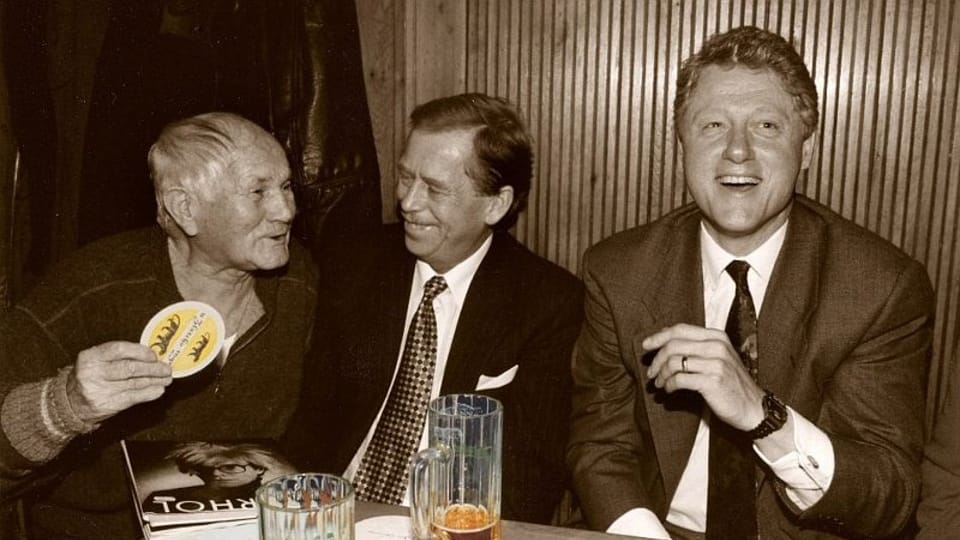
When you mention Havel and Clinton to Czechs, what first comes to mind is you playing the saxophone in Reduta, the Prague jazz club, and of course you going for a beer with him casually, as if nothing was going on, in our iconic, historic pub At the Golden Tiger.
“Yes, I did. Both those things happened. I remember when we went to the Reduta club. One of the things that he was doing at the time was trying to find ways to accelerate the Czech Republic's ability to succeed in a more open economy.

"During the Cold War, the Soviet Union had assigned to various countries in Central and Eastern Europe the responsibility of making instruments, musical instruments for the military bands. And from my perspective, the Czech Republic got lucky: They wanted them to make saxophones. So Havel basically adopted this company that was making saxophones and put his little heart logo on them. And he gave me one in the club and they invited me to play. I love it – it was a good horn. It's now prominently on display in my library. Everyone who comes to my presidential library and looks at the exhibits sees the saxophone that Havel gave me. Because I thought it was a perfect representative of what we were trying to do. I miss playing it. I’ve got a lot of these saxophones, including two that were made by the creator of the saxophone, Adolphe Sax, who was in Belgium at the time. Music brings people together and he got that – like most everything else.”
I don't think many Czechs knew back then that you played saxophone, and played it so well. I used to play saxophone, but alto saxophone, and I know that the tenor that you play is a different deal – that’s the real thing. Do you still get to play today?
“It's very interesting; I think I would have gotten good marks from Havel.
"As you might imagine, America's been in some turmoil, so I went back to work full-time and I stopped playing for almost three years. And recently I was asked to play, just as a tribute to a friend of mine who was leaving his work. I started playing again and there was a young man from our area who's now a professional saxophonist in Miami, married to a woman who's a professional trumpet player. He came by and started working with me, and I hadn't played in three years. And in the second hour of our efforts, he said, ‘You were once pretty good, weren't you?’ I said, ‘Yeah, I was, a long time ago.’ He said, ‘Well, you can't ever quit for three years again. When you're over 75, you cannot quit like that. But it'll keep you alive longer if you keep playing.’ So, I'm back to playing.”
If this is the strongest memory of you and Václav Havel for most Czechs, what would be your strongest memory of him?
“My strongest memory of him always will revolve around our private conversations. Because he would say to me, over and over again, ‘We have to trust freedom, we have to trust democracy. People will often make decisions we disagree with. Things will go backwards as well as forwards. But if people are free, truly free in a system which favours both majority rule and minority rights and which preserves individual liberties, things will work out in the end. We have to believe that.’ He believed that. And so do I. That's why you see so many of these authoritarian governments, including, I'm sad to say, on occasion my own, trying to silence dissent. Whereas democratic governments encourage dissent; they want people to say what they think and believe that in an imperfect world, diverse groups will make better decisions over the long run than totally homogeneous groups and certainly than dictators.”
Were there also moments when you and Havel did not think the same, where would you differ in your opinions?
“Well, I think if it had been up to him, I would have had the Czech Republic join NATO a couple of years earlier. But he knew that I was also trying to preserve the position of President Yeltsin in Russia. Because of all the Russian politicians he was by far the most committed to having good relationships with his neighbours and letting them go their own way and building a world of cooperation, not conflict and dominance.

"So we had the meeting in Madrid and voted to let the Czech Republic and Poland and Hungary into NATO. And then we left the door open to 44 other countries, who were in our Partnership for Peace. As you know, after I left office, President Bush supported including more countries in NATO.
"And the United States for the most part has strongly supported the Ukrainians in their conflict with Russia. The Trump administration has been more ambivalent, because he tends to like authoritarian figures, but I don't think they make better decisions. I think President Putin is a very smart man. I think if you're more interested in conserving your own power and building your own wealth, then in the end, you'll leave a lot of people out and a lot of people behind.”
Was it Havel who persuaded you to push for NATO enlargement, because there was opposition even within your administration?
“There was. It wasn’t him – Madeleine Albright had a lot to do with it. Before Havel and I started working together, I advocated expanding NATO. And I went to the middle of the country, to Milwaukee as I remember, to a place where there were a lot of people from Central and Eastern Europe, and said we ought to do this – we ought to give these people a chance to be part of a free society, and you can't do it without a security framework. It's naive to believe that a lot of these countries can come out of the Warsaw Pact and into freedom without having any kind of security framework. And we recognise that a lot of these countries weren't yet ready to join NATO, that is they couldn't comply with its obligations to help in other places. That's what we set up the Partnership for Peace. So we had training exercises every summer and worked on all these things, sometimes for years. And after I left office, I was pleased to see President Bush and Congress taking so many countries into NATO. And we had a total consensus on this among the leadership of the two parties until the last couple of years.
"So I think we just have to keep ploughing ahead. I think again I would say I think diversity works better then groups who all think the same and certainly better than dictators. I just believe that, and I think there's lots of evidence on it. And Havel also said that without the United States, the Czech Republic would never have joined NATO.”
Looking at Europe today with the war in Ukraine, was enlargement the right call, in your view?
“Oh, absolutely. At the time I left office, we didn't know what would happen in Ukraine, so I just kept working with them, and it was obvious that they considered themselves independent. But Putin's position was that Khrushchev freed Ukraine, if you will, only because he assumed it would always be part of the Soviet Union. That was Putin's argument. I remember talking to him in 2010. I think that's the last time I went to the meeting at Davos and Putin wanted to see me. He was in his first term and was much more moderate, but he was very straightforward. He said ‘I just don't think this is legitimate.’ So I came home and reported this to the Secretary of State, who was then my wife, and to the White House, to President Obama, and I told them that Putin didn’t bluff – he was coming for Ukraine. And pretty soon he went after Crimea. Then later the rest. So this has been going on a long time.”
If you were the president today, what would you have done differently towards Ukraine?

“I would have made it clear that I and my NATO partners are going to support Ukraine to the bitter end. And I would have tried to make sure that they didn't run out of weapons. Everything has changed a lot now, because drones are so important and the Ukrainians, bless their hearts, deserve a lot of credit for their advances in drone technology. So I think that they’ve still got a good chance to make it, but the problem is they can't afford to do it on their own – and I think we should stick with them till the end. If they decide they want to give up the war, that should be their decision, but we should meanwhile say that whatever they decide, we will support them. They're an independent country and they deserve this.
“You know, there's a lot of a lot of controversy because South-eastern Ukraine is very rich in rare earths and minerals, and all the big countries in the world need more of them to feed the growing demands of information technology and artificial intelligence and all that. So we'll see. But I really have a high opinion of them and they're very gifted and they have been very brave. And I'm hoping they make it.”
When you last saw Václav Havel in New York, it was 2010. Do you remember what you talked about?
“I had no idea then he didn't have long to live. I knew he had battled with cancer, on and off, for years. But we talked a lot about what the Czech Republic was facing. And I remember I supported him strongly when he oversaw the peaceful separation of the Czech Republic and Slovakia. He thought it was the right thing to do. He thought that's what the Slovaks wanted, and he didn't want to be in a position of denying other people the freedoms that he wanted the Czechs to have. And he thought that there were enough people in both areas that they could actually function as successful countries. And he knew their politics would be somewhat different.
"So, we basically went back through all that. And then we talked about what was going to happen in the future, and we admitted that we didn't know for sure. But he said, ‘You have to be willing to pay the price of time and have a steely determination to save a democracy. There are always people who want to get rid of it, but it's harder to bring back if you let it go away.’ So we talked about that, and as always we had a good time talking. I loved being with him. Once he went to dinner with just me and my daughter, and once we had a memorable dinner where it was just the two of us and I just thought he was truly terrific. And we met at Madeleine's a lot; he and Dagmar would always be there and I'd come over and see them.
“I can honestly say, I don't know that I enjoyed being with anybody in politics more than him. He and I were friends. I got very close to Helmut Kohl, which was interesting, because our politics were a little different. And I was really close to Mandela. But they were all people who believed in freedom. And who did not think they should stay for life. They thought they should do their time, render their service and go on with their lives. And we need to get that back.”
Do you think of Vaclav Havel often?
“Often. We still have our home in Washington and if you come there it's covered with photographs on the wall of people that I really cared about. And one of the first things you see is the jazz club; I never will forget that night, as long as I live. And I never forget the fact that when I started playing – and Havel gave me the saxophone and then he played his little tambourine – this guy just walked in and started playing with us and he was much better than I was. Way better. And he was an accountant, a Czech accountant from Milwaukee. I asked why he was there and he said, ‘Because my native land needs me more than Milwaukee does. You’ve got to keep up with things. If you want a democracy, accountants are important. You have to keep the money straight.’ That guy was unbelievable, and an amazing musician. Every time I listen to that record – which I think the Czechs put out – of us playing in the club that night, you can hear this guy playing and how good he is. I think about him and what it represented that he was free to move back and forth; he had a good life in America, but he loved his native land and he knew that it needed him more. I think you need people who want to show up when they're needed, because there's always a reason not to do it. You can always think ‘I wish I could have done that, but I didn’t’. But this guy didn't make any excuses. He just showed up. The only release he had from his daily work was showing up at the club and playing jazz.
“Also I think on his 90th birthday, people should remember that Havel never claimed to have all the answers, but he knew how things should be done. And he was never discouraged when people made decisions he didn't agree with. He just kept plugging. And I think that we need a good dose of people who are willing to keep going in the face of disappointment. Because one of the reasons that a lot of these autocrats are doing well around the world now is that people thought, ‘Well, I voted for democracy, and I still don't like my job. I voted for democracy, and the economy is still not great. I voted for democracy, but I wish we didn't have so many immigrants.’ And that is really ludicrous in America, because nobody is more dependent on its immigrants than we are. There was an article in our press a month or so ago saying, ‘America had a good month last month – we created 60,000 new jobs.’ But we averaged 220,000 jobs a month in the eight years that I served. And we welcomed immigrants. We still had background checks, if somebody was a serious criminal or something. We sent plenty of people back, but on balance, people knew that we wanted America to be tied more closely to the rest of the world, not just taking money away from people, and taking power away from people. And I still think – you know, it's a simple formula – addition is better than subtraction, and multiplying is better than dividing. It works better, and we need to get back to it.
“And I only wish Havel were around today to write a few more letters, make a few more speeches and make people laugh. Because the other thing he understood was that people get very defensive when they're angry or afraid, and you relax them if you can make them laugh – and maybe they listen. And he certainly got a lot of people to listen to him.”
Did he make you laugh?
“All the time. All the time. I remember clearly so many of our conversations and it was always a joy to me. And even when he was clearly suffering from his own health problems he kept laughing. I think he was grateful for every new day. When the sun came up in the morning, I think he silently celebrated it, every single day.”
Related
-

Václav Havel remembered
Czech democracy leader Václav Havel was born 90 years ago this October. We speak to several people who were close to the dissident playwright-turned-president.