Wolfgang Beltracchi, once Europe’s most notorious art forger, is exhibiting in Prague

For decades, Wolfgang Beltracchi fooled the art world with paintings he passed off as lost works by famous artists. Now the German former forger is exhibiting his own paintings in Prague.
His works hung in galleries, museums and private collections as supposedly rediscovered masterpieces. However, they were not copies of existing paintings. Beltracchi created entirely new works, invented their stories and provenance, and convinced galleries, auction houses and experts around the world that they were authentic.

His downfall came when investigators discovered that one supposedly historic painting contained a pigment that did not yet exist at the time it was allegedly created. Beltracchi was later convicted in one of Europe’s biggest art forgery scandals. The judge estimated the damages at around €16 million, covering only the proven cases. Of his six-year sentence, he served roughly half.
Speaking to Czech Radio at the opening of his exhibition at Prague’s Municipal House, Beltracchi explained that his forgeries were never simple copies. Instead, he says he would absorb a painter’s style and create entirely new works in that artistic “handwriting”.
“In my former profession as a forger, I usually needed about 10 minutes to understand the handwriting. I look at the painting and absorb it. Every painting is movement in colour, and time is important, whether the movement is slow, quick, done with the left hand or the right hand. After five or ten minutes I can see the handwriting, and then I can create a new work in that handwriting. Not a copy, but a new painting that never existed before.”
Beltracchi says he worked in the styles of around 120 painters across four centuries and claims many of his forged works are still hanging in museums and collections around the world.
“All my paintings were accepted by major experts around the world. Last year they found one in the National Museum in Madrid. It had hung there beside Picasso works for about 33 years. They also found three in museums in Japan. Every year they discover some more.”
The 75-year-old painter, known for his trademark hat and long grey hair, says he was already selling his own art successfully in the 1970s, but was drawn to a different lifestyle.

“I was already selling my own paintings for large sums in the 1970s. They paid me 10,000 Deutsche Marks for a painting, which was what my father earned in a year. The problem wasn’t that I wasn’t accepted. I was simply different. I was a hippie, I took drugs, I listened to music, and I was always on the road. I bought hundreds of Old Master paintings, and eventually I told myself I would simply make them myself. It was easier.”
Beltracchi says what set him apart from other forgers was his ability to work across many different styles and historical periods, whether creating a pop-art painting or working in the style of Leonardo da Vinci. He describes the process as a kind of “free method painting”, similar to method acting.
“Free method painting means something like free method acting. You enter the mind of the painter, just as an actor enters another person. You want to become that person, to get inside their mind. That is the main task. And in painting, I do exactly the same thing.”

But, he says, convincing forgery required years of experience and an almost obsessive attention to detail.
“It takes at least ten years of experience to do it properly without mistakes. It’s incredibly difficult. You must be a painter, a restorer, understand science, pigments, drawing, restoration. Everything must be perfect. If it’s not 100 percent correct, you risk prison.”
Today, Beltracchi continues to move freely between very different artistic styles. That range is on full display in the exhibition Divine Stories, which features more than 80 paintings and sculptures created between 2010 and 2026, exploring themes such as temptation, truth, punishment and redemption. Most of the works belong to private collectors.
The artists says he deliberately avoids developing one recognisable style of his own.
“I don’t like repetition; I’m not a machine. I create maybe ten or twelve paintings a year, no more. I think about what works for the story, what I want to create, and what kind of signature I want to give it. You can call it style, but I don’t like that word. I don’t have a style. Sometimes people at exhibitions ask me, ‘Mr. Beltracchi, which painting is yours?’ I tell them: ‘All of them, but every one is different.’”
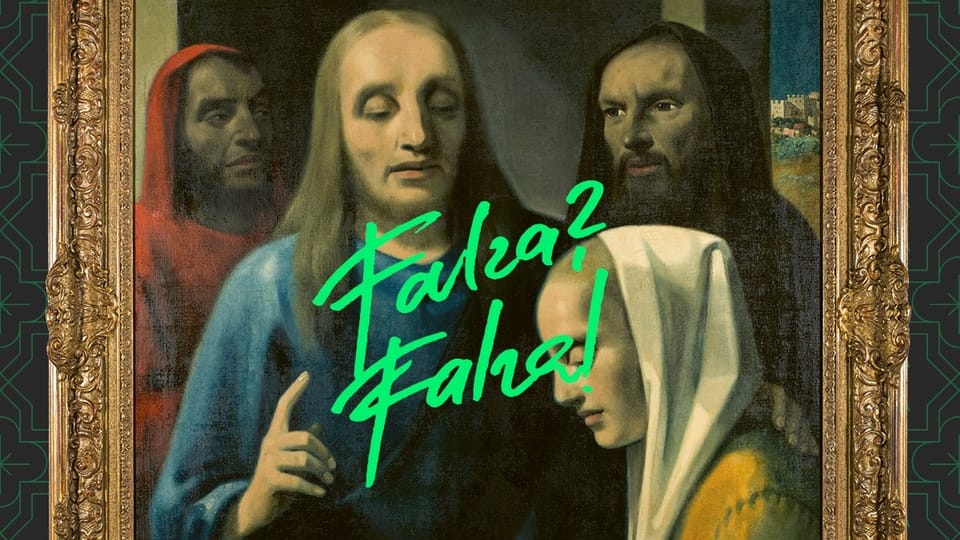
Even today, Beltracchi’s work continues to be viewed through the lens of his extraordinary forgery career. Some art historians, however, question parts of his account of those years and argue that he has turned his criminal past into a powerful personal brand.
The exhibition Divine Stories, featuring his current paintings, runs at Prague’s Municipal House until September.