William Kentridge at Kunsthalle Praha: “Jan Švankmajer showed me you don’t need to do Hollywood animation”

A new exhibition of work by the major international artist William Kentridge at Kunsthalle Praha looks set to be one of the art events of the year in the Czech capital. Entitled The Battle Between YES and NO, it includes animated films, sculptural works – and a piece dedicated to Franz Kafka created especially for the show. I spoke to the South African-born Kentridge, who is 70, at a press preview.

There’s such a variety of works here. Is there a through line for you?
“Gosh, I think the through line of the exhibition is to be made by people watching it.
“The through line would be the ‘excess of the studio’, the way different projects expand from the studio and meet each other. Images from one project move across and meet and another.

“Bottles and jugs which are sculptures in one room appear in the film about Marseille in another. They reappear in Kafka’s film. The woman doing exercises in the Kafka film goes upstairs [in the gallery] to the Trotsky film.
“So there’s that movement, and it’s very much about the migration of images and sound from one piece to another.”
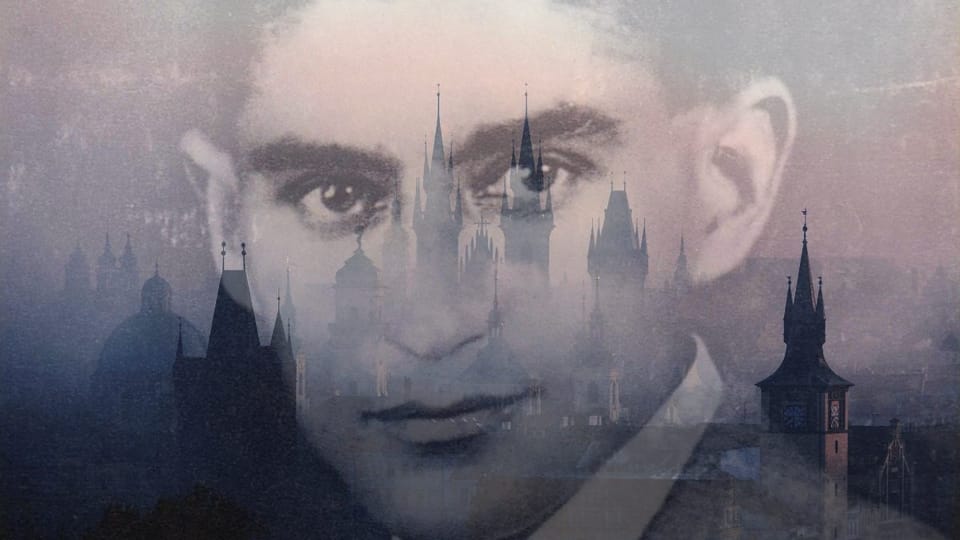
You’ve created one work for this exhibition, A Letter to Felice, with Felice Bauer being a one-time lover of Kafka’s. What was the main idea behind that work, and how did you go about shaping it?
“I suppose the main idea was to find a connection to Prague, to do a piece specifically for it, and being influenced by and having a love of the writer, that seemed natural.

“But the piece itself was made by taking different lines from 20 or 30 different stories, putting them on a table, rearranging them and seeing what story emerged.
“And then working with a very simple form of motion capture and collage to make the puppet figures of Kafka and Felice; they then perform inside this miniature theatre like a holographic diorama.”
READ ALSO
Was it a bit of journey for you, getting to know more about Kafka by doing this work?
“It was. For example, I hadn’t known about his interest in a particular form of physical exercise that he used to do every morning.
“I hadn’t known that Felice worked in a company that made recording machines, so there’s a duet between Kafka and a recording machine.

“Lots of different pieces of information that came through about Kafka – either friends told me, or I discovered them – went into the piece.
“So it’s the stories, but it’s also more than the stories.”
Earlier you were saying that you were a fan of some Czech artists, including Jan Švankmajer and Jiří Trnka, who made films using animation. What in particular did you like about them?

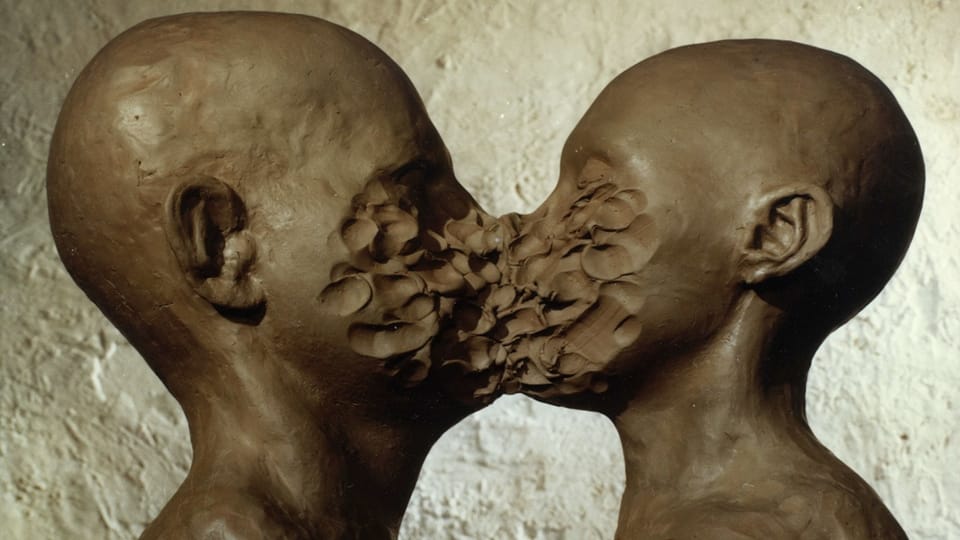
“I suppose with Švankmajer, even though the sensibility is very different to mine – there’s a different kind of surrealism that he’s interested in – I was astonished at those clay heads and those teeth and those mouths and those eyes, and then his longer, narrative work.

“But for me it was about saying, You don’t have to do ‘Tex Avery’ Hollywood animation with a huge industrial studio – you can work in a much more craft way, singlehandedly with your own hands making the film.
“I think that was the key thing I learned from that.”
There’s a kind of cone-like speaker with the Kafka film, and upstairs there are some huge ones. What’s the idea behind those?
“The megaphones, as you say, migrate from one project to another.


“They’re a very good way of directing sound, so they have a really practical purpose; of all the different ways of directing sound, for me they’re the most efficient.

“If you stand in the ambit of the cone, in the angle of the cone, you can have a very soft sound that you hear very clearly.
“But there’s also something about the graphic image of that triangular cone – it’s an object that meets the activity of drawing halfway.”

The Guardian said of you, “Cinema is in every fibre of his being”. Did you ever consider being a “straightforward” filmmaker?
“I did, and I was invited to do it, but I realised that to that you firstly have to have a strong narrative skill.
“Secondly, you have to have a good psychological understanding, and thirdly, you’ve got to be able to write dialogue.
“None of those three do I possess, so these fragmented stories, which are half narrative, which you have to construct yourself as a viewer, became the only way of working narratively for me.
“In my theatre projects often we’ve worked with longer narratives, but that’s usually a given, from the text you’re working with.
“But I suspect I would not be a good director of a feature film.”
Related
-

Masters of Czech animated film
The Czech Republic has a long history of animation, dating back to cinema’s silent era.