The Grandmother translator Susan Reynolds on bringing Czech classic to English-speaking readers
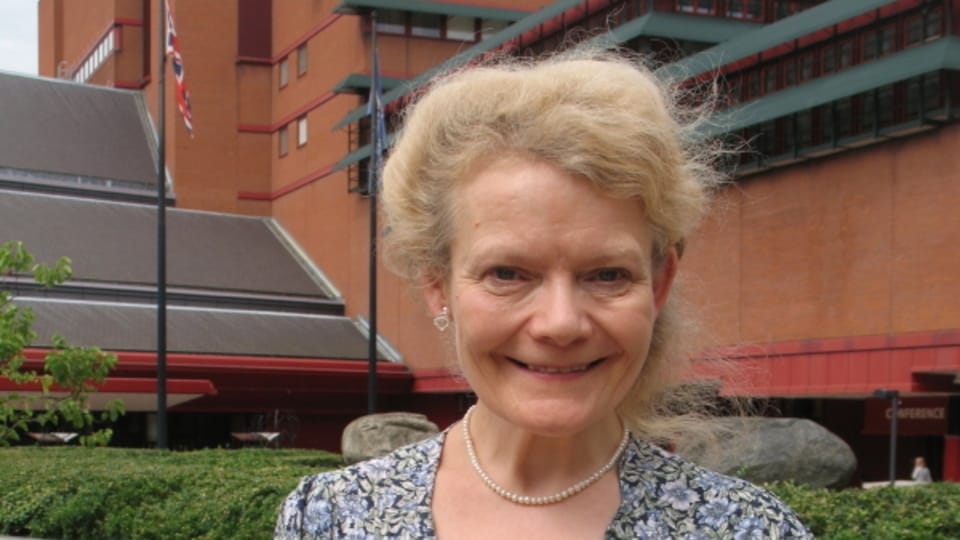
A new translation of one of the most important books in Czech literature, The Grandmother (Babička) by Božena Němcová, will be launched by the UK-based Jantar Publishing at the end of this month. It’s the work of Englishwoman Susan Reynolds, who previously produced an acclaimed translation of another Czech classic, Karel Jaromír Erben’s Kytice. I spoke to Reynolds about how she approached rendering The Grandmother (originally published in 1855) in English, its author’s pioneering spirit and more.
What led you to Czech in the first place? Your publisher, Mike Tate, tells me you came to Czech after many, many other languages.

“Yes. Really I came to Czech for musical reasons. It was back in the 1970s, when Sir Charles Mackerras was first making the operas of Janáček popular in England.
“The first one I heard was Příhody lišky Bystroušky, The Cunning Little Vixen, and I was absolutely bowled over by it. It was the Glyndebourne 1977 production, I think.
“And when I read that Janáček was fascinated by speech patterns and natural sounds, and how they could be translated into music, I thought that I would appreciate his operas even better if I could at least read Czech.
“In those days, of course, not many Czechs got out.
“I already had a reading knowledge of Russian and Polish, so I had something to build on – so I worked on Czech as well.
“But for a long time it was very much passive knowledge, because you didn’t really have a chance to meet many Czechs and speak it.
“Then in the early 1990s, literally in the last days of the old Czechoslovakia, I went to Prague for the first time for family reasons with my two young children.
“Shortly before we went out I was complaining to the father of one of my son’s friends that I had never had a chance to learn to speak Czech.
“And he said he had a colleague who taught Czech at university and I should go to his classes.
“This was the late James Norton, to whom we all have a great debt, the author of Colloquial Czech and Colloquial Slovak.
“I was convinced that he had plenty of proper students and wouldn’t want me wasting his time. But after a telephone call he said, Yes, yes, do come along. So I did.
“Now the only class I could attend with any regularity for family reasons was his Czech text class, and we were studying Mácha’s Maj.
“After that we were told to look at other key works of Czech literature, including of course Kytice.
“I was already familiar with Kytice, because of the Dvořák symphonic ballads based on its poems, but I was surprised there was no complete English translation of it at that time.
“And when I was given a little copy of Kytice by Jim Norton, I could see why this was. The longest poem is over 300 lines long, and each of the 13 is written in a different rhyme scheme, a different meter.
“And I felt it was important to render those in English, because Erben himself was a musician, as well as a scholar, and if you listen to the Dvořák symphonic ballads, you can hear echoes of the words in the music.
“So I started, right in the middle of what I think in English is known as The Spectre’s Bride, ‘the Wedding Shirts’, and from that it branched out and I translated all 13 of them.”
Also you were the curator of the Czech and Slovak collections at the British Library in London, where you work. How big are those collections, and what does that work entail?
“I went there in 2004 and for 10 very happy years I held that post, until there was restructuring and curatorships for individual languages were abolished.
“People often ask how many Czech books we have in the collection, and the answer is it’s impossible to count them, because we don’t have a designated Czech section.
“I worked before I went to the British Library at the Taylor Institution Library in Oxford in the Slavonic and Modern Greek Department, which was organised quite differently, and systematically; if you want a Czech book, you know exactly where to go and look for them.
“But the British Library has them scattered among all of its different sections.
“Some of them were acquired en bloc, others came piecemeal, and then, when I was there, we were by this time actually ordering books.
“We acquired books in two ways, either by exchange, through some of our partners, or by purchase.
“So although we acquired them in these ways, they weren’t catalogued accordingly. So it’s impossible to say exactly how many we have, though of course it does run to several thousand, if not more.”
As you say you previously translated Kytice. In a few weeks’ time we’ll see the publication of your translation of Babička, The Grandmother. Is it daunting to you at all taking on these classic Czech works of literature?
READ ALSO

“Certainly. It felt like a huge responsibility. Because Kytice is still known and loved and quoted by the average Czech in the street. And it’s impossible to please everybody.
“For translating Kytice you have very specific requirements, of course. As well as a linguistic background, it does help if you are a musician, and if possible a poet as well, which fortunately I was, so that made my job a lot easier.
“But also you have to have a grounding not only in Czech literature, but in the literature, specifically the poetry, of your own language, so you can look at what was happening in English poetry at the same time as Erben was writing and see if you can create resonances, echoes – not of course direct imitations, but something which will give the English reader a sort of doorway into the literature of what was contemporary poetry at the time.
“With Babička the challenge is quite different. Again, it’s one of the best-loved and most treasured works of 19th century literature, and you cannot hope to make everyone happy.
“And there was also a challenge, which didn’t really exist with Kytice – at that point there were no complete English translations, whereas with Babička there were two already.
“And I don’t think I would have ventured to translate it had Mike [Tate, publisher] not said to me, We think we need a new translation.
“The oldest one comes from the 1890s and the second one from the 1970s.
“The first was made by a native Czech speaker who learnt English later on, the second a native English speaker, the novelist Ellis Peters [real name Edith Pargeter], who of course learnt Czech when she went to what was then Czechoslovakia herself.
“So I was coming to this through these other translations, which I had to look at. Of course I wasn’t going to lift things bodily from them, but I did need to have a look and see what was there and what was not.
“I was coming to Babička through these other translations, which I had to look at.”
“For example, our tutor of Czech, Rajendra Chitnis, said that sometimes he mentioned passages from Babička to his students and they looked blank, the reason being that at that stage they had not read the original – they had only read a translation.
“And from the Francis Gregor, or Františka Gregorová, translation there were actually bits missing.
“For example, when Babička comes and visits her grandchildren she asks her oldest granddaughter, Barunka, to comb her hair for lice, and that is missing from the earliest translation, possibly because it was felt not be refined enough for readers and would put them off.
“So I had to translate the whole thing and I had to have the two translations next to me.
“From the Francis Gregor, or Františka Gregorová, translation there were actually bits missing.”
“While it’s very easy to get hold of the Francis Gregor one, the later one is much, much harder to find. It was printed in a much smaller print run, and I think in the United States, so it wasn’t automatically acquired by legal deposit by the British Library.
“However, we do have a copy – the Taylorian has one – but I couldn’t buy one to look at home. Then, of course, came the pandemic, and fortunately I was able to borrow the Taylorian copy and look at that as well.
“That was enormously helpful, seeing how in many ways Ellis Peters had anglicised things. For example, she changed the names of the children; Barunka becomes Babi.
“I felt that was something I shouldn’t do – we need to preserve the native Czech flavour of the original.
“Then of course there all kinds of folk songs, bits of folk poetry, woven into the text. And fortunately I had some kind of background with the Kytice translation.
“But I did feel that it was important, again, to keep the rhythms, to make them sound like Czech folk poetry.
“Then there were all these references as well, which have to be woven in. What I didn’t do was add footnotes – that would have interrupted the flow of the reading.
“So there were all these different ways of looking at things. Also I was trying to make it not consciously dialect, but certainly to give it a kind of folk quality.
“I didn’t want to make it specific to one area of the British Isles. I remember when Jim [James Norton] was translating Bohumil Hrabal he made Uncle Pepík, who was Moravian, into a Scots dialect speaker.
“One of his reviewers took issue with this and said it wasn’t entirely authentic. But that fact that Jim was Scots himself did make this rather amusing.
“But anyway, sometimes I do feel I need to give it a bit of local colour, but not something that pegs it to one area of Britain.”
I presume the Czech in the original is, to some degree at least, archaic. Were you trying to render it in modern-day English, or 19th century English? What was your aim?
“Well if I made it consciously 19th century it would have made it stilted, archaic and difficult for a modern reader.
“So I tried as far as possible to go for a timeless quality.
“But what was helpful again, as with Erben, was to look at what was happening in world literature at the time, in English particularly, and see whether there were any texts that were still read and loved by young and adult readers nowadays.
“And I thought, Yes, possibly something like Louisa Alcott’s Little Women, or Susan Coolidge’s What Katie Did.
“Now, we don’t have quite the same in English literature. Yes, we do have Dickens, but he is much more of his time, and he’s read quite often as a school or college text, rather than being picked up and read by younger readers at an earlier age.
“So that again was quite helpful.”
For you, how does The Grandmother stand up for modern readers? Is it something that you think will appeal to people today?
“It certainly will, because although it’s specific to a time and place, many of the issues which it treats are timeless as well.
“Although it’s specific to a time and place, many of the issues it treats are timeless.”
“The whole thing about national identity and linguistic identity, of course, is very apparent nowadays.
“When certain languages are in danger of dying out, which fortunately Czech is not, then people do tie their national identity and their linguistic identity close together.
“There is a passage, for example, where Babička is talking about how, after her husband’s death, they have the possibility of receiving an army pension.
“This would have meant placing her three children in army-run schools and institutions; the boy would have gone into the military later on, and the girls would have gone to an institute for female orphans.
“But this would have meant, she said, they’re becoming strangers to her. She would have lost contact with them, and when she met them again they would have been speaking German.
“She felt this was something she could not allow, so she said, Thank you, she would do without the pension but she would keep her children and they would grow up speaking Czech.
“Later on her older daughter, Terezka, marries a German-speaker and this fellow says, Why did she choose a German?
“Notice, she [Babička] calls him German, but of course he was a German-speaker, no matter what his ethnicity.
“But then she says, We get on well now, and as for the grandchildren, they’re my very own.
“And those grandchildren explain how they speak Czech with their mother but they speak German with their father.
“Then when Barunka describes how at school they have dictation and she does this for one of her classmates, she says, Well, if she wants to learn German later on, she can always go to Germany, can’t she?
“So there is this dual linguistic identity that the grandchildren have and that is very topical nowadays too – how you identify yourself through your language or your ethnicity.
“And the whole theme of education for girls is something which Němcová herself felt very, very strongly about.
“She contributed to the founding of the first girls’ grammar school and she could see that education was absolutely key for women’s emancipation and for women having a sense of agency and being able to support themselves.”
What’s your general impression of Božena Němcová? I guess she in many ways she was a pioneering writer?
“Yes, of course she was. Because not only was she earning her living through her writing, which was unusual at the time, but also she travelled through Slovakia, when her husband was posted there, and collected folk songs and folk poetry, just as Erben had done.
“So she was doing exactly the same thing as one of the most illustrious male contemporaries.

“But while Erben went on to become an archivist, her own approach was much more that of a collector of national heritage, which she wanted to make accessible to young as well as older readers, hence her collections of Czech and Slovak folk tales and fairy tales.
“Then her own writing, of course, was not confined to Babička. In fact, when I was talking to Mike about what I might translate next I said I’d very much like to translate some of her other, less-known fiction.
“He said, Yes, possibly, but let’s start with Babička, because we need a new one first of all. And once people have been inspired to read Babička, they may want to explore further and say, What else did she write?
“Božena Němcová was an extremely forward-looking woman, far ahead of her time.”
“So I hope there will be other possibilities there.
“So yes, she was an extremely forward-looking woman, far ahead of her time, and she could see that opportunities for girls were going to be important in the future and she could make a serious contribution towards this.
“She had a daughter of her own. Sadly she did not live to become a grandmother herself, but you might describe her as the grandmother of Czech literature.”
Do you have a favourite character in the grandmother? My wife was saying that the character of Viktorka is by far the most interesting.
“Yes, she is. Because she’s a woman who transgresses social norms, and yet, as one of the other characters says, ignorance is no sin.
“She commits what is seen socially as a sin, without any knowledge of the impact it’s going to have on her life…
“Of course Grandmother herself is… well, she’s completely out of the running, because she IS the whole book.
“And while I was translating it, I became a grandmother myself four times over. Not quite symmetrical: I have not two granddaughters and two grandsons – I have three granddaughters and one grandson.
“While I was translating it, I became a grandmother myself four times over.”
“And I could see how, as a kind of repository for inherited knowledge, this was a sort of duty we all have as grandmothers and mothers – to pass these things on.
“So yes, I feel she was a kind of mentor for me, as well.
“And then little Barunka herself is, obviously, closely influenced by her grandmother and takes on this tradition. Indeed literally, because Němcová herself was doing precisely the same thing when she wrote the novel and embodied all this folk wisdom within it.”
What are your hopes for your new translation of Babička, in terms of perhaps establishing a reputation for that book, or for Němcová herself?
“Well, first of all I hope we introduce her to readers who have never heard of her, as a lot had never heard of Erben.
“Because it will make the book accessible immediately, and I hope readable and appealing.
“It will perhaps inspire them to ask, What else did she write? Or, What was going on in Czech literature at the time?
“Because over recent years, especially since the Velvet Revolution, a lot of the Czech literature that has been translated, and which we’re very glad to have in English, has been 20th century literature.
“And of course over the last week we sustained a great loss with the death of Ivan Klíma, who I was honoured to meet some years ago, when he was in London.
“So I hope that it will inspire readers to go further, perhaps, into the history of Czech literature as well, to realise that these are not old, dead classics.
“The famous saying about a classic is that it’s something everyone wants to have read but nobody wants to read.
“So when you cannot read it because it’s in a language that you can’t read, that’s an additional barrier.
“And I hope that in keeping with Jantar’s motto of ‘freeing works that have been trapped in amber’ [jantar is Czech for amber], so to speak, it will lead more readers to read, and not only read but to enjoy, this novel and also many other classics of Czech literature – and, one hopes, to create a demand for more translations.”