Czech-Vietnamese director Dužan Duong: I’m torn between two worlds – but I use this as an advantage
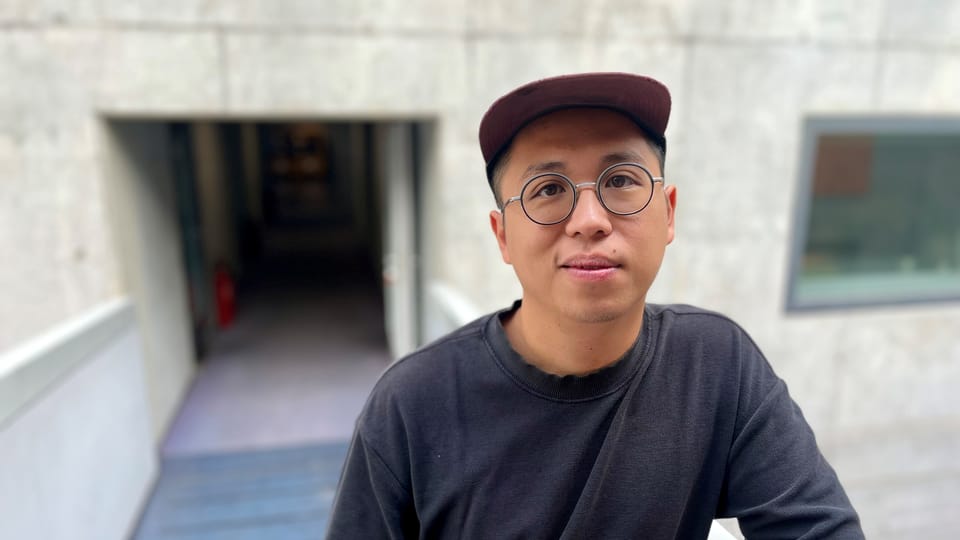
Writer-director Dužan Duong made a big splash at this month’s Karlovy Vary International Film Festival with his debut Summer School, 2001. Dubbed the “first Czech-Viet” movie, it recreates aspects of the 34-year-old’s own childhood, much of which was spent around an outdoor market near the border with Germany. When we met recently the conversation took in the making of Duong’s breakout film, his own background and Czechia’s large and thriving Vietnamese community.
You moved here to Czechia at the age of four. What was the background to that move? Where had you been before?
“So my parents met in the ‘80s in Germany, in a factory. And that’s where I was, like, made [laughs].
“But after some years my mum and my dad had to leave Germany and went to Vietnam.
“During that time my father tried to get back here to Europe. He managed to get to the Czech Republic and he worked here for, like, three years.
“And when he had enough money he brought me and my mother here.”
I saw a quote from you where you said your two-year-old child speaks Vietnamese better than you. How come?
“I think the biggest reason is I spent most of my childhood with my Czech nanny, so I was gradually forgetting the language.
“When I was six I was sent to Vietnam but I spent only three months – my Czech nanny persuaded my parents they should reverse their decision.”
Dužan Duong
“All I had was Czech culture and Czech.
“But my son is growing up with his loving parents, and grandparents who are Vietnamese, so he gets to learn Vietnamese.
“So that’s my second chance to learn.”
Where does the name Dužan come from? There is a name Dušan.
“So Dušan… my mum opened a [Czech] calendar with names and my birthday is around April 9 [‘name day’ of Dušan] so she picked this name for me.
“But when I was a teenager, I was like 15, I was getting rebellious and I decided that Dušan was no longer for me, I will be Dužan.
“Because it felt much more manly [laughs].”
It’s the only one. I googled it and couldn’t find a second Dužan.
“Yeah.”
One of the characters in your film Summer School, 2001 is sent back to Vietnam as a child to be with relatives. Is that common? And is it something that also happened to you?
“As we shot the film we learned that this story happened to most of the cast, so we were really surprised that this niche topic for the Vietnamese community is so relevant for most of the immigrant families here.
“And it also happened to me, but with a little twist.
“When I was six I was sent there but I spent only three months, because my Czech nanny somehow persuaded my parents that they should reverse their decision and then I was back here in the Czech Republic.”
Was it the case, as I read, that the woman who plays the mother in your film sent her child to Vietnam during the making of the movie?

“Yes. And just recently – yesterday – she went to Vietnam to bring her son back to the Czech Republic.”
Why do people do that? What’s the reason?
“I think there are some reasons.
“One of them is that during that time, 2001, Vietnamese merchants were worried about their futures and they didn’t know if they would stay here for another 10 or 20 years.
“So they just decided that at the age of six, which is when you go to the first school year, you should go to Vietnam and start going to school.”
Part of the film is shot in Vietnam. As an adult, how do you enjoy going there?
“It was a pain, but also a joy. Because when we were shooting in Vietnam we had some troubles with the local government, even though we had a permit.
“So it was quite painful, but also quite rewarding once we finished the shoot.
“And I’ve always liked Vietnamese cuisine and the people around it. It’s something new always for me.”

But do you feel, to some degree, at home there, or are you always an outsider now?
“I think I’m an outsider with a good insight into the culture [laughs].
“I always feel torn, in between worlds, but I’m not complaining; I’m just using this as an advantage.”
I understand that the market we see in the film is similar to one that you spent a lot of time at as a kid.
“[In Vietnam] I’m an outsider with a good insight into the culture”
Dužan Duong
“Yes. My childhood was awesome. When you are a child you don’t have that many struggles and you don’t think about very important stuff – you just want to have fun.
“So that’s why I made this film, because part of me still wants to be a child.
“We used to have this market, Dragoun, which was the centerpiece of the community.”
This was in Cheb?
“In Cheb, yeah, which is by the border with Germany.”
Which is why you have German characters in the film and this interaction with the German side.
“The Germans were the biggest customers for the Vietnamese communities living by the borders.”
Also I was here in those days, in 2001, and the market feels really authentic. How did you find recreating that world?
“We had a lot of photos from that period, from my family albums and other friends’ family albums, so we had a lot of material.

“We also had the best team in our art department, who could do magic with a limited budget.
“That was one of the things that I wanted to have almost perfect.
“I don’t find it that perfect, but for viewers who will see the film for the first time I think it will be enough [laughs].”
What did your parents think when of you entering the film world, when you decided to go in that direction?
“I think they didn’t take it too seriously. I was studying economics during that time so they were thinking I was just messing around.
“But once it got more serious I got their attention.”
And you graduated in economics and not in film, is that the case?
“Yes.”
And you’ve done mainly commercial work over the last 10 years or something?
“Yes, I’ve been doing commercial work for, like, six years. Because I was writing the film for quite a long time and you have to get paid for something.
“That’s why I was doing some commercial work, as a cinematographer.”

Do you enjoy the commercial stuff, or is only a means to an end?
“[Laughs] So at first I did see my career in commercial work.
“But then I learned the hard truth that the clients are always right, and they have the right to change everything, even though you don’t think it’s the right decision.
“So my motivation to remain in commercial work gradually went away.
“I’m glad that I did this part of my work, but I’m also glad that I can get to make movies now.”
Summer School, 2001 made a big splash at the Karlovy Vary film festival. You were in the Special Screenings section, which is a prestigious place to be. How did you get selected for that section?
“That was our aim from the beginning, because we knew that if you get into Special Screenings you get to show your film in the Grand Hall at Thermal.
“We knew if you get into Special Screenings [at Karlovy Vary] you get to show your film in the Grand Hall at Thermal.
Dužan Duong
“That was our aim, because you will get the attention and the spotlight.
“And we showed this film to [festival artistic director] Karel Och and his team half a year ago or so and they decided in a week, so we knew that this was going to happen.
“Also they asked us if we wanted to compete in the Proxima competition [for emerging directors and bold projects], but we didn’t feel like this film would be a good fit for this section.”
How much did you enjoy the premiere? It looked amazing.
“Yes, we tried to enjoy ourselves and we tried to not overthink anything.
“We just went with the flow and I think it worked out.”

It’s been called the “first Czech-Viet” film. Do you feel a kind of pressure to impress both sides, to get it right in a way that makes both sides satisfied with the outcome?
“Yes, of course. The pressure is here. But the film is already finished and already locked.
“So the pressure is a little bit not important right now, because you cannot do anything about it.
“All I can do is talk to you and other reporters and people and explain my ideas.

“But the best outcome is I don’t have to explain anything and the film will communicate itself.”
There’s one scene in the film where the characters are at home in their apartment and they are fixing the labels of big brands, like Puma and so on, onto non-brand clothes. They have enormous piles of labels for Adidas and the like. Was that something that you saw at home as a kid?
“Yes, 100 percent. I hope my parents won’t get jailed for that, but that’s my childhood.
“I saw my dad making these fakes and I was always surprised how easy it was to make this branded clothing.”
About the casting of the film, were there enough decent or experienced Vietnamese actors in this country for you to choose from?
“We knew that the pool was big, but not the pool of professional actors.

“We knew that we had a pretty big community, so we decided to do street/Facebook casting.
“So my colleague Valerie somehow managed to get involved in the Vietnamese community, even though she cannot speak the language.
“She found me 100 non-actors. Some of them were actors – three or four people – but the vast majority were non-actors.”
Did that pose any particular challenges for you, to get them through the process?
“I saw my dad making these fakes and I was always surprised how easy it was to make this branded clothing.”
Dužan Duong
“No. I prefer working with people with no experience. Because their schedule is more open than with professional actors, and they don’t have these bad habits of being famous.
“So it’s a joy for me.
“And Vietnamese people know how to improvise, and that’s what I like doing on a film set.”
Did you give them room to create their own lines?
“Yes, the lines weren’t that important for me. I just knew that a particular scene should end with some meaning – so I just guided them through the whole scene, only telling them, The ending should be this.”

As well as presenting your new film at Karlovy Vary, you also presented a new project called Lost Boys, which is an animated series. What is that exactly?
“It’s my new project I’m developing with the same team who did Summer School.
“It’s a story about technologies and how they are consuming us. The online world is much more present than the offline. You could have a screen time of 10, 11 hours, if you are not careful.
“I think this is the big issue for the upcoming generation, Gen Alpha.
“It’s the story of a Vietnamese girl who is 12 years old and she has this struggle that she’s more online than offline.
“Vietnamese people know how to improvise, and that’s what I like doing on a film set.”
Dužan Duong
“One time she comes across these real fight videos, of local boys fighting each other, and she gets this thrill of this offline world.
“She tries to join the boys’ club, but she learns that she needs to become a boy so that she can join this Lost Boys club.
“So she’s living a double life and it’s about finding the balance in those extremes.”
Do you have experience with animation? Or why animation?
“No, I don’t have any experience. But I like to be challenged and I like to try new things.”
Also I saw that the release date for this project is 2030. Are you technology will have sped up even more by then and we’ll be in a different place in five year, technologically?
“I’m thinking that what this story is about… that this issue will be more visible in the future.
“So I’m thinking it will be the right time to be released, actually.”
My impression of the Vietnamese community in this country is that they’re very successful, hardworking. When I first came here in the ‘90s they had stands. Then they had shops. They still have shops but now all their kids go to top universities and, like you, study things like economics. Do you ever sense that they are resented by the Czechs for being so successful? For putting their heads down, working hard and getting rich?
“No, I think the Czech people actually love the Vietnamese.
“First, it’s the cuisine. The common language for the two nations is these Vietnamese meals that can make everybody happy.

“Secondly, it’s the services. Like you said, the shops and everything. They are always open and the Czechs love it.
“If they forget their cigarettes they can just go downstairs and buy the cigarettes.
“And even though the Vietnamese people are quite rich, they are also quite generous – you could see that during the pandemic.”
Also quite modest. At least in front of the majority community, they don’t really show their wealth, it seems to me.
“Yes, Vietnamese people don’t like to show their wealth.
“They like to tell their kids that they don’t have any money [laughs].”

Are they offended when Czechs are simply ignorant? The common thing you hear about is how Czechs speak to them informally, without any kind of right to do that. But the thing I find craziest is when Czech people call Vietnamese “Chinese”. That is so ignorant.
“[Laughs] Yeah, it kind of is. But I can relate, because if I was a white man who had no interest in Asia these people would look almost the same to me as well.”
But nobody’s thinking there are Chinese corner shops everywhere. Everybody knows that they’re Vietnamese. To me saying that they’re Chinese is just willful ignorance.
“Yeah. But I don’t take it too personally. It is what it is.
“I cannot change their minds. All I can do is make more films.
“And my generation can get these Vietnamese insights into Czech culture – so we could change it.”
The other side of this coin is I often wonder how older Vietnamese people in particular view Czech people. Because they work so much harder, it seems to me, than Czechs.
“Vietnamese people don’t like to show their wealth. They tell their kids they don’t have any money.”
Dužan Duong
“Yes. People from the shops think that every Czech drinks beer and smokes cigarettes and eats salty food.
“This is the stereotype from the Vietnamese community.”
But they don’t think the Czechs are lazy or something?
“Yeah, some of them might be lazy, but some of them are super hype. It depends.”
How do you foresee things going in the future for Vietnamese people? Will they be just increasingly successful and wealthy and maybe in 10 years all their shops will be staffed by Czechs?
“I think yes [laughs]. Because the Vietnamese will develop their businesses.
“You will see a lot of mixed families also.”
Is that happening a lot?
“Yes. I think it’s happening now already. I have a few friends who have Czech husbands.
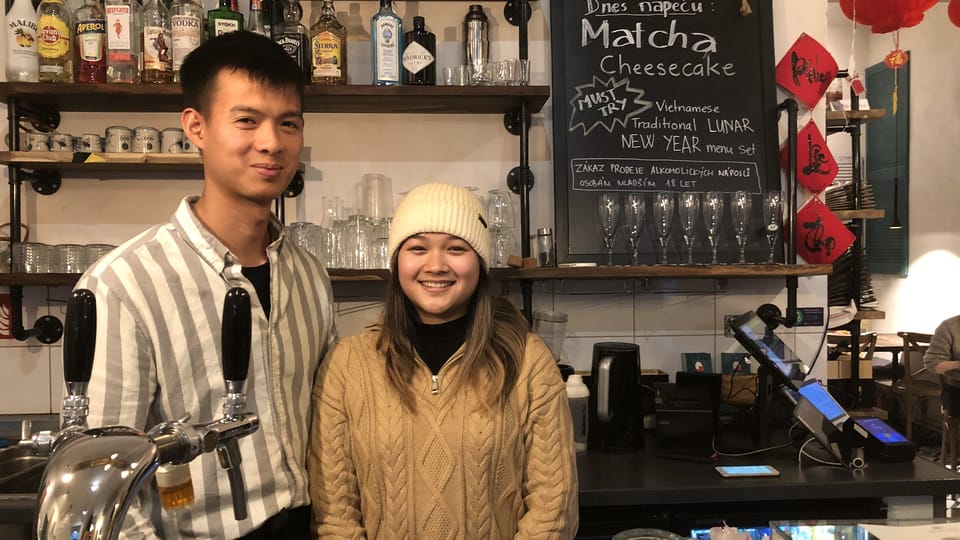
“So it will happen for sure, and I think it will only enrich our society. Like I said, we have a really good relationship.”
Does it happen that you get more Vietnamese girls and Czech guys than the other way around?
“Yes. I was just discussing this yesterday.
“I think in the early days it was more common to have a Czech boyfriend and a Vietnamese girlfriend.
“But with this Asian sensation boom, I think the Vietnamese boys will also get the chance to date white girls.”
Are there any issues with that in the community? Is there any negative view of marrying outside the ethnic group?
“I think there is still some prejudice. Like, This marriage won’t last that long – and the language is a problem.
“But with the new generation the language won’t be a problem and the culture won’t be a problem either.
“Because we will bring the culture. We will, like, open up.”