Isabel Stainsby: My parents said, “We forbid you from studying Czech” – Don’t say that to a teenager

Isabel Stainsby is the translator of a gripping memoir by Roma journalist Patrik Banga, which has just been launched in English under the title The True Way Out. Stainsby, who lives in Scotland, first developed an interest in the Czech language – and this country – in her teens. We discussed her work as a translator, love of Czech castles and more after the presentation of the book in Prague.
What led you to Czech in the first place?
“The short answer is I first came to Prague when I was 17. I made some good friends, including one friend for life, and just absolutely fell in love with the city, the country and the people.
“I went home and said to my parents, I’m going to study Czech at university.
“They said, No, you’re not – that’s a terrible idea, we forbid you.
“Don’t say that to a teenager.
“The slightly longer answer is I’ve pretty much always been fascinated by languages.
“I was lucky enough to start learning French at school at the age of eight and was instantly fascinated: different words, different structures, but you can put them together and still use them to communicate.
“Then a few years later, at secondary school, I started learning German and that was as exciting.
“So I knew that I wanted to study languages at university for about as long as I was aware that there were such things as universities and that I would one day go to one.”
To rewind a tiny bit, why did you come here at the age of 17?
“It was 1991. Communism was still a very recent memory. The former communist world was just opening up – and we could go there.
“I came over with a small group of friends to meet some friends that we had here.
“I think it was two weeks – it was quite a long time I was here – and it was lovely. And I’ve been coming back ever since.”
What was so lovely? What were the things that you enjoyed on that first visit?
“Meeting the people. And as for actual things, I think I have to say castles; I do have a bit of a thing about castles and the Czech Republic has some of the best in the world.”
Still for a group of English teenagers to say, Let’s go to Prague, seems quite unusual.
“I suppose it was. It was part of a youth project within the church I was going to.
READ ALSO
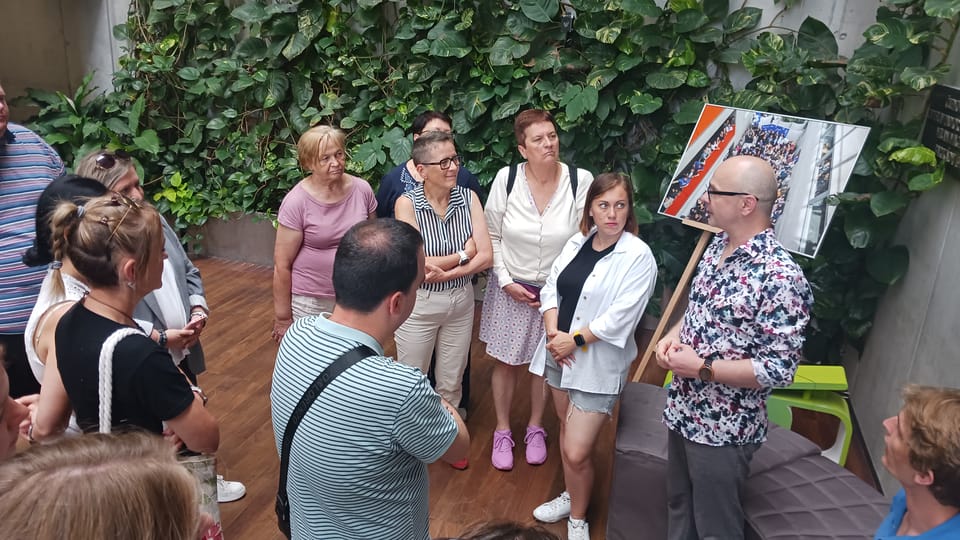
“We’d reached out to various churches in former communist Europe.
“We’d had a youth weekend in the UK, in England, where people from the Czech Republic, Hungary, Poland, East Germany and Romania came over. And the Czechs invited us to go back.”
What was the Czech church you were affiliated with?
“I wasn’t, the people who invited us were. It’s not that far from here. It’s on Vinohradská – the Baptist church there.”
Looking back do you understand your parents’ opposition to you studying Czech? Or Czech and Slovak, it was, right?
“Czech and Slovak, yes.
“I suppose so, yes. French certainly will take you around half the world, German is a very good language to have in quite a lot of Europe and Czech is really only spoken in the Czech Republic.
“So I kind of get where they were coming from. But they have since admitted that they were wrong – they see that I’ve made a career out of it.”
It was Czech and Slovak – were they studied equally?
“Not really. We did some Slovak literature. We got handouts on the differences between Czech and Slovak: sound differences, different words, that sort of thing.
“But we didn’t really study the Slovak language as such.
“I’ve made up for that since: I have regular lessons with a private teacher these days.”
You went to Cambridge. What was it like studying Czech, and Slovak, there?
“It was an experience and a half. My teacher was Karel Brušák. He’s not as well known here as he really should be. He was a minor poet in his own right. He was 80ish when I first started studying.
“My teacher was Karel Brušák. He’s not as well known here as he really should be.”
“He used to hang out with the poetists. He knew Nezval and Seifert and Biebl and he used to tell some stories about them that I probably shouldn’t repeat on the radio.
“He was a character. He was also a very good teacher. He inspired a lot of his students and a lot of us did really quite well as a result of his teaching.”
How did he end up in Cambridge?
“I’m not 100 percent sure, but he ended up in the UK, I think, after the war. He was a refugee from communism, I think.”
I guess studying a language like Czech, you must have had relatively small groups, or classes?
“When I started there were five of us, and that was actually an unheard of large number; normally you’d only get one or two a year.
“A couple of them fell by the way by the final year. But yes, there were a few of us.”
How do you maintain your Czech at this distance? Also it’s quite a long time since you studied it.
“It is. But I come back here regularly, I have regular contact with friends here.
“Also, as a translator, I’m in contact with Czech clients on a regular basis, which means even if I’m not speaking the language I’m reading and writing it. My written Czech has certainly improved hugely.”
When you’re working for clients here, I presume you’re competing for work against people who are living here and therefore have a cheaper lifestyle, slightly at least, than you. Does that put you at a financial disadvantage?
“Sometimes probably yes. But because I work in other languages too I can… I’m sure my Czech clients will be very amused to know that my German and Swiss clients are charged considerably more, which subsidises them.”
We met last week. You were here for the launch of the book The True Way out by Patrik Banga, which you translated. Could you describe this book to listeners?
“Well, obviously they should read it.
“It’s a memoir of growing up in Prague in the 1990s and early 2000s. Patrik Banga is a Roma, with everything that implies.
“My Czech clients will be amused to know my German and Swiss clients are charged considerably more, which subsidises them.”
“His family never had much money, his parents worked several jobs to keep them financially afloat.
“He faced a great deal of prejudice and discrimination when he was growing up. He was arrested by the police many times, even while still a child, beaten up [by the police].
“There were problems, for example, because he didn’t have an ID card, though he wasn’t yet 15, so he didn’t have to carry one at that point.
“He describes going around a department store with two white friends. They were stopped by security and the two white friends were treated politely and he was yelled at and made to empty his pockets.
“The one thing they had from the store they had paid for and then he got beaten up because he hadn’t stolen anything.
“There are lots of stories like that in the book. It is not easy reading, but it is compelling.”
How was it for you translating it?
“It was a challenge. Emotionally it was quite hard. As I just described, there’s a lot of violence in it and that was quite difficult.
“But there’s also a cracking story in there about how Patrik overcomes adversity and some of the absolutely crazy things that he did, like heading off to Montenegro to work in a refugee camp and then coming back to Prague and raise money and collect clothes and food to take back to the refugee camp and dealing with all the paperwork that he needed to cross Europe and that sort of thing.
“It’s quite a ride.”
And doing so when he was 17, if I remember correctly?
“Yes, he was 17.”
That’s really amazing. Also you write in your afterword to the translation that you were concerned about the question of privilege. What did you mean by that, and why were you concerned about it?
“As I say in my afterword, literary translation is a largely white, middle-class profession and I have to plead guilty on both counts.
“That is at least partly because it is not very well-paid. I’m fortunate that my husband earns a lot more than me; if he didn’t, or if I was single, then I couldn’t do it.
“That is automatically going to exclude people from poorer backgrounds.
“Literary translation is a largely white, middle-class profession and I have to plead guilty on both counts."
“I also think that we need to be aware of privilege. Obviously you don’t know how your own privilege benefits you because you’re used to the way things are – it’s always been like that for you.
“So you don’t maybe stop to think about the fact that having white skin or being a native English speaker or being well educated opens doors for you in a way that other people can only dream of.”
I understand that in life, but I can’t really see why it pertains to translating. How does it affect the way you translate, if you have more advantages in life?
“I don’t know if it affects how I translate. It’s the fact that I can translate. I don’t need to do something that earns me more money.
“Also it’s worth noting that the book itself is about privilege. Despite everything that Patrik goes through, he goes to the refugee camp and he sees children rummaging through bins to find food and realises that however awful his life was in Prague, he was a lot better off than these refugees.
“So it’s all relative, to a certain extent.”
And he was better off than many Romanies in this country – his family weren’t as impoverished as many.
“Oh, yes. His parents had jobs. The police thought that was very funny on at least one occasion, that they had jobs.”
If you had a problem with the text, if there was a word you didn’t know or whatever, did you consult with Patrik? Or did you find another way to get around that problem?
“The final text of the book was sent to Patrik when it was completed, so I got feedback, mostly from his wife, Lenka.

“Having seen Patrik the other night, I think Patrik’s English is better than he pretends, but it’s still not that good. But Lenka’s English is excellent; she was able to read it and make a lot of suggestions, which was very helpful.
“Before that there’s a rather wonderful group on Facebook called Czechlist – the pun is intended – where people post questions and you can answer them; I posted a couple of things there and got some quite interesting comments back.”
And as well as also doing work like contracts and so on, you translate Czech sci-fi novels?
“Yes. Again I met the author, Jan Kotouč, on Czechlist. He was looking for an English translator. I’ve always loved science fiction, so I responded.
“He sent me a short extract to translate, which I did and he said, Can we go ahead with this? And we agreed terms and I translated the book.
“It was only a couple of years later that I heard that I had been one of five people to contact him and he’d had to have some sort of beauty contest to choose who he was going to work with. That was quite nice.
“The books are enormous fun: lots of explosions in space, alien races, distant planets, politics, intrigue, love, rabbits. I really enjoy doing that.”
But is high literature harder to translate than, say, sci-fi?
“I wouldn’t say so. Everything is going to have its challenges, everything is going to have things where you go, Yes, I know exactly what I’m doing here, and things where you go, How the hell am I going to translate this?
“The style in high literature might be harder, but the actual content probably not.
“And with science fiction I actually had to make up a couple of words, because Jan had made up words so I had to as well.”
One thing I’m curious about with all translators, and I myself translate, is how the issue of AI is affecting the art of translating. How do you feel it’s impacting your work? Or is it?
“I don’t use AI myself. But I have noticed that my commercial work has dropped off quite a lot in the last year or so, and I think that’s down to AI.
“I think more companies are using it, so they’re not commissioning translators or translation agencies to do the work.
“The problem with AI, and to a lesser extent with machine translation, is that things do converge.”
“Which is worrying, because AI… yes, if you want a rough translation or a general gist, fine – but if you want the subtleties and the nuances, if you want the unexpected things…
“AI can probably do a contract, no problem, but when you’ve got giant, alien lizards in space who are pointing guns at you, AI is really going to struggle.”
So you’ve never tried it at all?
“No.”
On principle?
“On principle.”
I’ve got to confess something. Sometimes I’ve actually translated, say, a paragraph and I think, I’ll just put it through the AI and see what it does – and sometimes it comes up with better solutions than me and I adjust what I have just translated.
“That is entirely possible. The thing that I’m scared of there is losing my voice and my style.”
Of course you have to edit whatever comes out of the AI machine.
“I have to edit what I produce too.

“But I think the problem with AI, and to a lesser extent with machine translation, like Google Translate or DeepL, is that things do converge.
“There’s a risk of losing your own unique style – and thus losing the original author’s voice – with the uniformity of it.”
Don’t you think whatever attitude you or I may have to it it’s just this big juggernaut that’s going to knock most of us out of the way anyway?
“That is certainly possible. I hope you’re wrong.”
I kind of hope so too, but I’m not optimistic. My final question is how often have you come back to Prague over the years, and how do you find being here?
“How often have I come back to Prague over the years? I can’t tell you that – too many times to count. This is already my second visit this year.
“I love seeing the way Prague has changed and developed all the time I’ve been coming.”
“And I love it. I love being here. I love seeing my friends. I love seeing the way the city has changed and developed all the time I’ve been coming.
“I love the opportunity to get out and see the rest of the country as well.
“I was here a month ago with my husband and we went to Olomouc, where I studied back in the mid-90s, and to Brno. He’d never been to Moravia before, so that was lovely.
“There’s always something new to discover.”
The True Way Out (original title Skutečná cesta ven) by Patrik Banga is published by CEEOL Press.






