Journalist Petr Brod on Czech-German relations and the place of radio in society

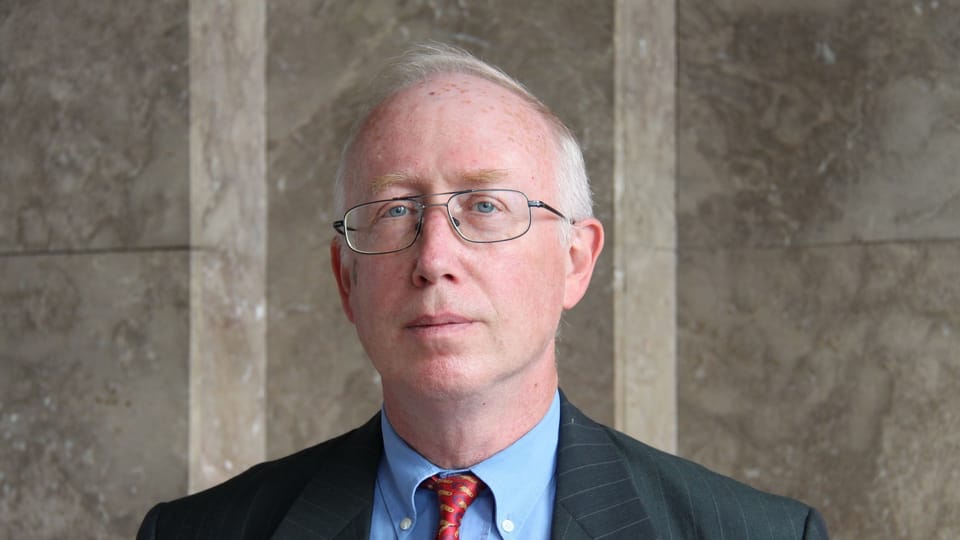
Petr Brod, a veteran journalist who grew up in a Jewish, German-speaking family in Prague and moved to West Germany in 1969, was one of the recipients of the Medal for Merit in Diplomacy on June 3rd.
After the ceremony at the Ministry of Foreign Affairs, he talked to Danny Bate about his dilemma over accepting the medal, his contribution to good Czech-German relations, and the role of radio in politics and society today.
How does it feel to be a recipient of this award?
“I was surprised in a way, because I'm not a professional diplomat. When the medal you get is called ‘for achievements in diplomacy’, then you feel you're in the wrong place to some extent. I'm a journalist. I have known in my life many diplomats and people dealing with foreign relations of various countries, that's true.

“But what my personal contribution to Czech diplomacy can be never occurred to me. So I had to think, when I was asked, whether I would accept the award. I had to think whether I was worth it and whether I did indeed contribute in any way to Czech diplomacy.
“I came to the conclusion that I can accept the award because for many years I've been especially active in the field of Czech-German relations, although I have some other favourite countries, like Great Britain and America, where I spent part of my life, partly studying, partly, working. So these countries could also come into mind.
“But I think that the main reason I was chosen to be one of the laureates is that the Czech-German relationship is of big importance to me. It is of course of big importance to this country; we're surrounded by the German element, if one includes the Austrian population, which speaks German. We Czechs are surrounded by German-speaking nations on three sides.
“Therefore the importance of Czech-German relations cannot be exaggerated. They were very deeply disturbed by the history of the twentieth century, in which Czechs and Germans twice at least stood against each other as enemies. There's still a lot to repair from that period and I have tried to contribute to this repair work as far as my abilities reach.
“One of the main channels for this activity is the Czech-German Fund for the Future, which is a bilateral agency sponsored by the governments of both countries. The main task of the agency or the fund is to support projects that bring together Czechs and Germans in a living cooperation, where they meet, where they create something together, or where they, for example, repair old churches in places abandoned by the German population of pre-war Czechoslovakia. All this comes within the purview of the fund, and I have been participating in the work of this fund for many years.
“Therefore I think I have contributed a bit to the improvement of Czech-German relations, which in the last thirty years or so has been great.”
Where do you still see room for improvement and repair work that still needs to be done in relations between the German-speaking countries and Czechia?
“It’s probably not the classical fields you would expect. I think our main problem is logistics – travel and connections, rail connections especially. It is still quite difficult to go to Munich from Prague for example. We don't have a high-speed track joining the two cities. It's a bit similar in the north, although the situation with the railway between Prague and Berlin is much better. But it can still be improved.

“I think it's these large logistical problems that need solutions from both sides that are highest on my mind, and that I would like to see solved. The improvement of the connection between Prague and Munich has been under review for the past 30 years, by the Czech, Bavarian and German governments and we have not seen much progress. So that's what I would like to see: more attention and more money coming in.”
Speaking as someone who has traveled fairly extensively in the border regions of this country, it's quite obvious when you are approaching the border, in terms of the houses and the infrastructure. But there have been some success stories: Cheb (in German: Eger), for example, has improved remarkably.
“It has. I'm glad that in Cheb, which I also occasionally visit, much has been done to save the old part of the town, which is really wonderful. There are many Gothic houses still extant, sometimes hidden behind a Baroque or Rococo facade, but it shows that the city was once a main crossroad between Bohemia and the larger Holy Roman Empire of which it was part. It was a so-called Reichstadt, an imperial city, which the emperors of the Holy Roman Empire devoted a lot of attention to.
“Much of this was lost due to the Second World War when Cheb was also damaged, and then it was further damaged by the Communists’ lack of investment and by a lack of attention devoted to the wonderful historical monuments of Cheb. So I'm glad that you now find the place also worth a visit, and I would highly recommend it.

“It has a wonderful art gallery with exhibitions, most of contemporary and modern art, whose importance goes way beyond Cheb, and is of national importance.”
And an international connection to Cheb that I was surprised to find out when I visited there was someone from my country, I believe a Scotsman, being involved in the assassination of a very prominent figure in the seventeenth century!
“Right, but you're forgiven, because Czechs are not united in their attitudes towards the victim of that famous murder. Albrecht von Wallenstein, the great military commander of the Czech lands, was a very prominent figure in the seventeenth century. He often changed sides, and one is not sure on which side he was on. In the end his demise came from an imperial order, because the emperor felt that this commander was going over to the Protestant side.
“Therefore I don't think that anybody in the Czech nation nowadays spends much time thinking whether Albrecht von Wallenstein, who came from an old Bohemian family, was really a Bohemian hero or not. He was fighting for his own interests in a very complicated time. His death has no influence on our modern times, but we take it as part of our history.

“Wallenstein was also important in developing some castles and areas of Bohemia, which became his dukedom in the north of Bohemia. So he is still an important figure, but what you call the assassination, which I would call a murder, is now part of old history.”
Nonetheless I still appreciate the expression of forgiveness towards Scotland and Ireland for that particular role. I'd like to turn to your time in radio and broadcasting. You have previously spoken about how radio played a large role in bringing about political change in the period of the 80s and the 90s. I'm thinking in particular of Radio Free Europe transmitting across the Iron Curtain. How do you see the role of radio today? We face our own political challenges now. Can traditional radio stations play a part?
“It's very difficult for me to judge, because I'm not very familiar with modern technologies. For example, radio has become divided into many various channels of different kinds. In my time, national public radio was something that everybody listened to all generations, and people found something in the transmissions for their interests. It was somehow one of the co-organisers of national life.

“That role has now become more difficult. There are so many competing radio stations of both public and private character, that it's difficult to generalise about the impact of radio on the population. But I still think that in a country like the Czech Republic, with a very strong radio tradition reaching back to the 1920s – we were, I think, one of the first nations, after Britain and its BBC, to start a regular public radio transmission – I think the Czech public radio will still maintain its function for many years to come.
“It won't be listened to live as much as it used to be, but people will simply select what interests them from channels, from online offerings and so on. There will be less of a national coming together around the radio set.”
Czech Radio (Český Rozhlas) still seems to occupy quite a central position though, compared to other countries and their radio stations. Is that fair to say?
“It does, yes. For somebody who's interested in news and comment or an explanation of political goings-on, Czech radio is indispensable. You don't get that much news and comment on private radio stations, who tend to concentrate on areas like lifestyle, music, sports. So Czech Radio is irreplaceable in this respect, and has a relatively wide network of correspondents abroad, a very dense network of correspondents at home in the Czech Republic, and has lots of regional stations, I think about twelve now.

“So everybody who lives in the Czech Republic can find something for himself or herself on the waves of Czech Radio. I think it's a very good station, although it sometimes has lapses, too. I think that, for example, in the news, the focus on Czech events is so strong that usually a Czech event is on the top of the newsreel at every full hour. I, with my training in international radio stations like the BBC and Radio Free Europe, sometimes freak out, because I don't think that the latest speculations about who's going to be the Czech Minister of Justice are really the top news item of the day!”