"Winton child" Felix Kafka (99): I feel Czech, British and Jewish
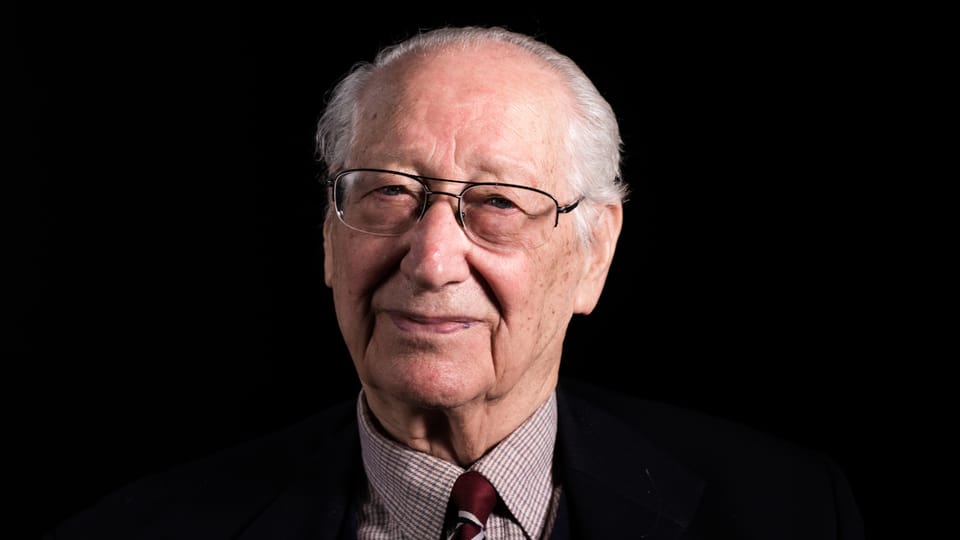
Felix Kafka was born in Prague almost exactly a century ago and escaped the Holocaust after being placed on one of the "kindertransports" to the UK organised by Nicholas Winton. He talked to Radio Prague International's Alex Rosenzweig from his home in England, where he has lived since 1939.
Felix Kafka, thank you very much for being with us. You were born on the 28th of June, 1925, in Prague.
"Correct."
What was your favorite place at the time in Prague when you were a kid?

"The street that we moved into when I began to go to school. It was Pařížská, Paris street. It was a big block of flats and we had a flat on the top floor and the school was sort of around the corner. It was pretty close to the river. That's about all I can remember, to be quite honest."
Was it a happy childhood for you?
"I think so, yes. I had a pretty happy childhood, generally."
You were part of the Maccabi sports organization, the Jewish sports organization.
"Oh, yes. We used to go to Maccabi to do some exercises. It was somewhere not very far from the center. "
As I said, you were born on the 28th of June, 1925, and exactly 14 years later, you emigrated. You embarked on one of these now famous trains, organized by, among others, Nicholas Winton. It was actually your birthday - do you have some memory of it?
"Well, I remember that indeed it was my birthday that I got onto the children's transport, and we were put on a train, and I remember that we, at least I regarded more as an exciting trip rather than anything else. But my parents, who put me together with my brother on the train, were very unhappy, which one can well understand."
I guess there were a lot of unhappy parents when you left.

"Indeed, there must have been. But to be honest, I don't really remember many of them. No, we were just on the train with a whole lot of children, and we just went off. Then we went through Germany, through Holland, and... Then, I think it was from the Hook of Holland that we went by boat to England."
Do you remember the arrival in England, the first day you arrived?
"Well, very vaguely again. My brother and I were a particular pair that... We didn't have a family collecting us, so we arrived not very far from Ipswich. And we went by train to London, were put again on the train, Ipswich, and somewhere near there we were put into... a refugee camp for children, which was... I think it was a school that happened to be empty at that time of the year, and we were put in there, and we were there for a while with a whole lot of other children."
Your father, Emil Kafka, was actually the head of the Jewish community in Prague, and he managed also to reach England a few months later. Do you remember when you met there?
"As far as I recall, he was sent actually by the Germans to France to negotiate about something or for paying for Jews leaving the occupied Czechoslovak Republic, and he came over to visit us while we were in the camp sometime at the end of September 1939, and while he was visiting us, I seem to recall the war started, the Germans invaded Poland, and all the frontiers were closed, so my father was left in England, and my mother was left in Prague. My father then, as far as I can recall, moved in with a friend in London, and eventually he became the assistant to one of the ministers in the Czech government in London."
The Czech government in exile, that was. During that time you started to study in England yourself?

"Well, from the camp, from the refugee camp near Ipswich, we moved down to somewhere in the south of England for a little while, to another camp or disused school or something of that sort, and from there, we then moved to Cheltenham College in Cheltenham, actually, to go to school, and so we went there for about three or four years, and when it came to what was then called the school certificate, I managed to pass it pretty well, and I then managed to go to university, to City and Guilds College in London University, and I stayed with my father."
What do you remember the most? Was it also the stress about not being able to communicate with your mother, Eliška, who stayed in Czechoslovakia? Was it the bombings of England at that time? What do you remember the most from that period in school?
"The only thing that I remember was, we wrote letters... through Switzerland, my parents had some friends in Switzerland, to whom we wrote the letters, and they then forwarded them to my mother, as far as I know, but, again, as far as I can recall, the flat where we used to live, and where my mother continued to live, was taken over by the Germans, and she moved, to live with some friends, and then, eventually, she was taken, by the Germans, to Lodz. That wasn't a concentration camp in Lodz, that was a part of the city..."
The Lodz ghetto. And from Lodz, she was deported to Auschwitz?

"From Lodz, she was then taken to Auschwitz, as far as I know, and from there, very fortunately, she was taken to another place where she worked, in some sort of a factory. If I remember correctly, the factory was making breathing masks, for, I don't know, the German army or something and that's how she managed to survive."
This year, there are going to be celebrations for the 80th anniversary of VE Day. Do you remember where you were on the 8th of May, 1945?
"I remember vaguely, as it were, when the war ended, but I couldn't honestly tell you where I was and what we were doing at that particular time. I was at the university, still with my father, as far as I know, with another family. In London. And then my father went back to Prague with the Czech government, and then he started looking for my mother, where she could be, whether she was indeed still alive and so on, and finally he found her. And then they got together again, and what happened in detail, I couldn't honestly tell you but they managed to get some sort of a flat in London, and that's where they lived. My father found my mother."
And do you remember the first time you came back to Prague?
"It must have been fairly soon after the end of the war. I went to a student's congress as a student. I went to this congress in Prague, and that's where I met my mother again for the first time after the war, in her flat. And I took one or two photographs, as I remember."
Did she ever tell you about her terrible experience during the war?
"We did not talk much about what happened to her, actually, during the war. I still keep on blaming myself, perhaps, for not asking enough questions, but I had the impression that she didn't want to talk about it very much, that her experiences in the forced labour and in Auschwitz and things like that, they must have been unpleasant enough for her not to want to talk about it. That at least is my impression now, because she talked very little about it, at least with me."
Your older brother, Jiri Pavel, joined the RAF in 1942. Were you scared about him? Did you want to join as well, at one point?
"Well, at that point, that's when I was starting my university, and I didn't really want to join, to be quite honest. It was, how should I say, worrying enough to have my brother in the RAF wondering whether he would survive and so on and so forth. So I kept on working in the university. I studied chemical engineering, and then when I got my first degree, I started working at the university as research on anti-aircraft rockets, and I worked there for four years. I got my doctorate, my PhD, and that was, as it were, my national service."
I know you still speak Czech very well. Do you feel Czech?
"That's a very difficult question, because I've lived now in England for, goodness knows, 85 years or so. And I feel Czech, and I feel British, and I feel Jewish, and it's all mixed up together. Although to be quite honest, I must say that in terms of Jewish, I tend to feel more religion rather than nationality. So I feel both Czech and British, put together. My Czech is all right, but I keep on forgetting words, and goodness knows, at my age, I tend to forget words in English as well. But, yes, as you probably know, I talk to my brother, or rather to his partner in Czech every day, and that keeps my Czech going."
Did you manage to pass some Czech language to your children?
"No, I'm afraid not. My wife was very English, and she was actually Church of England, not Jewish, and we brought our children very much in the English way. They probably know one or two Czech words, but that's about all that they know. They certainly can't speak Czech."
Did you meet Nicholas Winton yourself?

"Yes, I did. That was many years ago, when I met him here in England, maybe once or twice, that's about all. And I think, if I remember rightly, I met him again in Prague, and we sort of shook hands, and we talked for a little while, but more than that, I honestly don't know."
Have you met any other of the so-called Winton children?
"No, fair enough, I haven't. The trouble is that I've not been... Well, I lived in London for some years, but I've never actually met any people, any children that had been in the same children's transport or anything of that sort."
And looking back at this story, how do you see it now?
"I think it was extraordinarily lucky, to be honest, that Winton decided to help so many children, and from what I gather, he had to forge certain documents, goodness knows what, I don't know, but it was very, very fortunate, and my brother and I were very lucky to have got on children's transport to get out. That's the overall kind of a feeling that I have."
How do you think Europe and Czech Republic and the world should mark this 80th anniversary of the end of the war, according to you?
"I haven't given it a thought to be quite honest."
Is there something to celebrate, or does the world situation, with the actual situation and the war in Ukraine next to us, how this anniversary should be also a way to warn the next generations, according to you?
"I just hope that there will be peace and not war. I really do hope so. I hope that some sort of an agreement can be reached about Ukraine and all the other places where there is war, in Africa and in the Middle East and so on. As I say, I hope that some sort of an agreement can be reached. I've been out of politics for so long now that I don't know what I would suggest as terms of such a peace. But I hope that that will happen. What I'm most afraid of is that there should not be another world war."
For you, will the 8th of May be a special day this year, or not at all?
"No, it won't, I'm afraid. You probably know that my brother George was born in May, and that to me is more important, quite honestly."
Related
-

80 years ago: How did WWII end in the Czech lands?
Eighty years ago, the most destructive and lethal war in history approached its end. In this series we map the last stages of the war and its aftermath on Czech territory.
-

10 Incredible Stories From World War II
Jiří Klůc has travelled around the world to find the last survivors of WWII and record the stories of soldiers and ordinary people caught up in the conflict.