Pope Francis remembered: "He reached out to people all the time"

Tributes have been pouring in for Pope Francis since the Vatican announced the news of his death on Monday. Politicians, cultural figures, church dignitaries and ordinary people are recalling their meetings with him and commenting on the legacy he left behind. Here are a few selected quotes from interviews given to Czech Radio in the past week.
Roman Catholic priest Marek Orko Vácha: He lived as he preached
“It really seems like a godsend to me that the Lord let him remain with us for the whole of Easter. That he could give the crowd in St. Peter's Square, and the world at large, the traditional Urbi et Orbi blessing on Sunday before leaving this world.

For me, he was a man who never moved an inch from his convictions. He lived as he preached, and he died the same way. The humility, simplicity which he learned as a young priest, stayed with him throughout his life, no matter how high he was in office.
His closeness to people, his concern for them were very real. The fact that on Maundy Thursday he did not wash the feet of selected priests, but went to a prison to wash the feet of prisoners - even the feet of a Muslim prisoner – says it all. It wasn't a symbol for him, he was used to helping others all his life.”
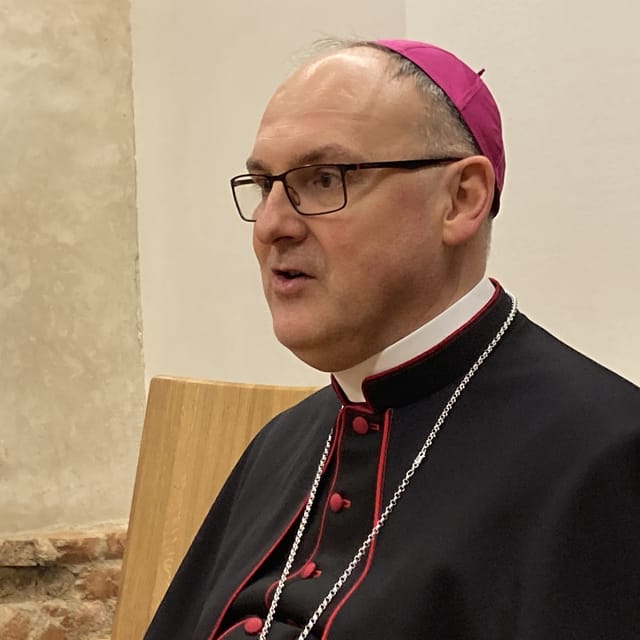
Bishop Tomáš Holub: He was ever ready to listen and learn
“I really cried when I heard that he had died. Tears came to my eyes because Pope Francis was a spiritual father to me. With his humility, openness, and kindness, Pope Francis touched the hearts not only of believers, but all who he came into contact with, who looked into his kind eyes. He was a pope who was really close to the people. I have heard that from many people around me. He had the gift of empathy and the ability to listen. He was always ready to listen and stressed that we should be able to see in others someone who can enrich us, even if they have different views.

“Pope Francis was really looking for new paths. That is indicative of his papacy - an openness in listening to everyone and a readiness to think about the way forward at a time when the world is changing. Long before we knew it for ourselves, he began to talk about the fact that we were really living in a time not of epochal change, but of a change of epochs. He said the Church must set out on a journey, and that it must be a journey where believers walk together. And on this journey the bishop must not be someone who is in the front, but someone walks with the people or even somewhere in the back and listens to those around him, to those arguing which way to go.”
He was patient, cheerful and kind:
“During the Ad Limina meeting, when he received Czech bishops in 2014, I brought him drawings from children with cancer from our Pilsen University Hospital. And I ventured to ask if I could record a greeting from him to them on my mobile phone.

And he said "You know what, good idea, we'll do it." So I picked up my phone and he started speaking, but I was terribly nervous and I hit the wrong icon on my screen and it failed to record. When he finished his greeting I blurted out, "Holy Father, I didn't hit record!" He looked at me, smiled and said, "OK, one more time, but please make sure you press record this time!" And he went through the whole greeting again.”
Archbishop of Prague Jan Graubner : He made Europe take a good look in the mirror

“We in Europe tend to be rather self-centered and inward-oriented, we are focused on our traditions, our standard of living and our rights. Pope Francis came from a completely different world and drew our attention to people who live in radically different circumstances. His focus on people on the margins of society, on the poor, on the excluded, on the undervalued, made Europe look beyond its borders and concerns. It was a very strong message. We live in a time when the Church is moving from Europe to other continents, and I think it was very important for him to open up that world view.”
Theologian Martin Vaňáč: He firmly believed that the voice of the faithful should be heard

“I think one of his greatest legacies will be that he started the so-called synodal process. In a way, the Catholic Church still operates a bit like a hierarchy, where wisdom and ideas flow from the top down. He started the process that there has to be a questioning, that there has to be - if church leaders are to decide something, to have a say on something - first a listening process, that the faithful have to be involved, that their voice has to be heard.
And another vital priority – which he took over from his predecessor Benedict XVI - is zero tolerance for sexual abuse.”
Cardinal Dominik Duka: His emotionally charged approach had a positive impact

"He repeatedly drew attention to the poverty in many parts of the world and the need to help. I think that was his greatest contribution. The Church in Latin America, where Francis came from, is more grassroots. Francis brought this approach to the functioning of the Church worldwide. The procedure that Europe or the U.S. is used to is more sophisticated and more administrative. Pope Francis’ approach was more emotionally charged and it had quite a positive impact on society.”
Catholic priest Pavel Ženíšek, of the Salesian General House in Rome: He emphasized the role of the Church to serve the people
“He wanted people to feel comfortable in the Church, to perceive it as an organization to which they can turn with confidence. I think one can see, when one is closer to the core here in the Vatican, that wherever there is power, there are also many people who abuse it. And that, I think, was hard for him to bear. He really emphasized the role of service and closeness to ordinary people, poor people. That is why he often went among the homeless.”
Catholic priest, philosopher, and theologian Tomáš Halík: He reached out to people all the time

“I was immensely pleased that Pope Francis read my book “The Afternoon of Christianity” and he wrote me a lovely, very personal letter about it. He so often reached out to people. He would very often pick up the phone and call someone who he knew was in difficult circumstances or was very ill. His openness, kindness and personal engagement was something we will always remember. He often used to end his speeches by saying “pray for me” and we will continue to do that.”