“Differences should be celebrated”: National Gallery Prague director on role of Czech art today

The National Gallery Prague is Czechia's foremost and largest art institution. Its goal is to preserve the nation's artistic heritage and promote it to both its domestic population and an international audience. With that goal in mind, what does it really mean to be a “national” gallery?
In today’s politicized climate, some would use the term to exclude and demote minorities. So, how does this celebrated art institution create a balance between celebrating Czech artists and recognizing the diverse nature of the country’s artistic heritage? I went to the Kinský Palace – one of the Gallery’s many exhibition spaces – in Prague's Old Town to meet with its director, Alicja Knast, to find out how she addresses this challenge.

“Your questions, which are obviously one part of this story, are also what concerns us, and these are the kind of everyday questions we ask ourselves. Mainly your first question—what 'national' means today and why we actually ask ourselves what it means.
“ 'National' means everyone who is part of that community, meaning, you know, really everyone across all genders and minorities. And we really try to do whatever we can to cover that and ensure that no one is excluded, whether through programming, collections, or audience development. We want that to be reflected in everything we do.
“It's not easy. We don't feel that we do everything we should in terms of accessibility. There will always be a barrier of money. In this part of the world, entry to galleries is paid, which shouldn’t be the case, as art and culture should be accessible to people from disadvantaged communities. But in this system, entry is paid, and will probably remain so for some time until there is political will to change it or political representatives feel that it’s more beneficial to remove that barrier and make it free.

“That is definitely our ambition, and we will always advocate for it. It's something we truly believe in, and the results are obvious. Everyone refers to free entry in the Anglo-Saxon world to galleries and museums, and we know it really increases the well-being of society, the understanding of identity, how it’s shaped, where we were, where we are going, and what we are going to do.
“I think it’s extremely important not to build that barrier in society. I’m very glad that libraries are free because the state pays for book loans. I personally have a dream that one day we can do the same.”
So when you're describing national, correct me if I'm wrong, you're already making it inclusive, diverse. Some would describe it differently.
“If you look at it as a difficult concept, then it will be difficult. For me, it’s extremely easy. Galleries and museums are places where differences are seen because they reflect society. We, as a team, should reflect society; therefore, we should be diverse in terms of generations, disabilities, and, you know, any type of minority you want to reflect upon.

“But we also really think that from time to time, this kind of reflection on what 'national' means is necessary. This institution has been named that way [National Gallery Prague] since 1949, when the state decided to name it this way. We are not the only ones. There are plenty of other institutions named this way, and it always reflects a need to have something representative.
“To us 'national' also means inclusion—it does not mean that we should reflect the current political representation; it’s not that. We should really see the differences and try to reflect them, not to balance them out, and really realize, of course, the state strategy, which is given, but also remember that art institutions are there to take people out of their comfort zones. Everyone, I mean, me, you, we should all really try to challenge ourselves in terms of what we know, what we believe in, and what we think is important.
READ ALSO
“Without this, we won’t move forward. Personally, I feel there are very few institutions or formats in culture that can reflect this. Museums are excellent in that way because they are very egalitarian; you can see the people coming, you see the diverse groups coming to the institution, and you have to cater to them.
“In the Czech environment, the one thing that’s difficult is that our buildings are located in listed buildings, meaning they are physically less accessible than we would like them to be. But otherwise, we feel this is something we discuss on a daily basis. It’s about physical accessibility, it’s about intellectual accessibility, and this discussion will never, ever end, I think.”
And so you're really receiving respect for the establishment, let's call it the political establishment or national establishment. But you're including all these minorities, you're listing some of them, so what's the role of activism in the National Gallery?
“Oh, that’s a very excellent question. I mean, artists are activists, full stop. Their aim is to make us think. So, activism is in the DNA of every artwork you see on the walls. We should not be an institution that says, 'Well, activism is something we don’t really accept as a phenomenon.' Far from it—that’s not what we are.

“But on the other hand, we would like to be part of the discussion as well. We don’t want to be a dehumanized entity because we do have our feelings, and we also have our values. So, the best approach is to discuss these issues openly. Yes, we should move from our positions as a team, and we have beautiful examples of such discussions.
“I won’t go into details, but I really strongly believe that when we express how we feel about these issues, we can do something better—together. Of course, with one condition: it should comply with the law. We cannot propagate hate speech or anything like that; that’s absolutely not acceptable. But that, I think, is obvious.
“It’s a painful process on both sides, because there can be anger within the institution when we do our job and try to protect heritage. But on the other hand, we are vulnerable. We will never be fully protected. But, you know, everything is about treasuring what’s ours and talking about it.
“One more point regarding this dialogue: our institution is not abstract. It is a group of people, meaning that they have their own values and emotions. They have decided to work here for a purpose, and very often, it’s not for money.”
So, could you say that the National Gallery is inherently protecting democratic values in that sense?
"Yeah, that is a very, very beautiful way of putting it, in a way that I might be too modest to word it this way, as you’ve worded it.
“But yes, that’s something I think, and the entire team, we very much strive for. It’s difficult to avoid making it just empty words. It’s also difficult to implement on our level, you know, within our team, because then we need to govern those processes in the same way we want them to be seen outside. Meaning, the way we decide on things is also—I'm not saying democratic, because there is someone who has to take responsibility—but definitely, it’s through discussion and some sort of, I wouldn’t say compromise, but I really like the word 'consensus.' I strongly believe that in mature groups, mature teams, this is possible, and it’s very satisfying.
“It might sound like a kind of paradise what I’m saying, but it’s not. There are conflicts, disagreements, and people who feel things should be done differently. So, I would like the listeners to know that it’s a very intense way of working within the team, but at the same time, the results are that we like each other, and we really care about each other. And that’s something that makes me think that maybe this method isn’t wrong. We just smoothly transitioned from a democratic society to working within the team, and I think it's extremely connected, because we can’t preach what we don’t do ourselves."

Speaking about conflict, I imagine that censorship is also connected to it. How do you decide what exhibitions to choose right now? There's a very politically charged environment, East versus West. Ukraine is distancing itself from Russian historical heritage and art. So, what's the role for censorship?
"Also, thank you very much for that question, because what we try to do is, first of all, decide for ourselves which topics we want to tackle. We also made a definition of the needs we need to address, and we know those needs are there. We know we should not be idle; we should do something about it. So, what was it? It was really the exiled artists who are not well-known here, but who were active abroad. In terms of capacity, we can do that because we are big enough to really see what was happening abroad and then present at least some of those artists to the Czech audience. That was one goal we set for ourselves.
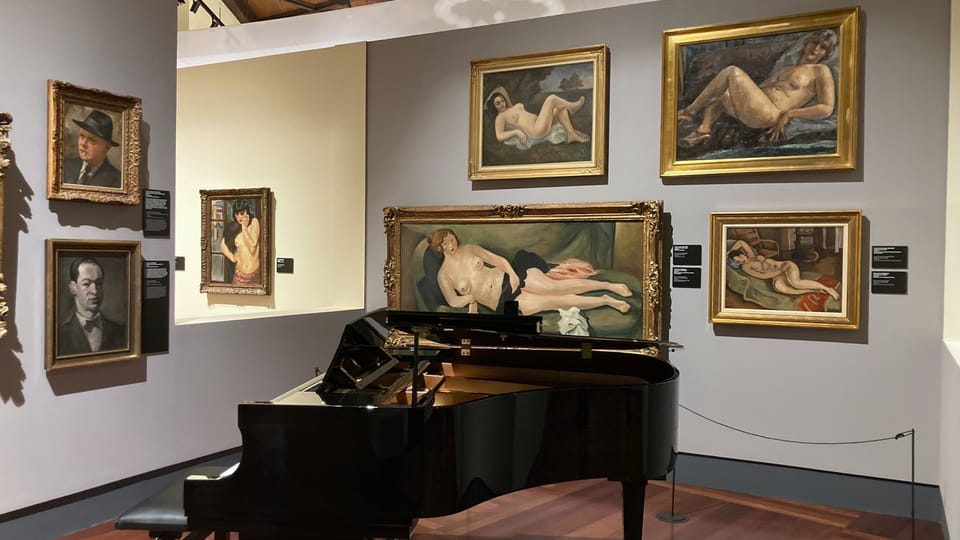
“Another goal was to rethink the role of women in art history, because by chance and due to historiographical reasons, the presence of female artists has been marginalized. So, we made a lot of proposals, which then turned out to be a pillar of our strategy—female artists. We’ve already done several exhibitions on this topic.
“Another topic we focused on is solidarity with Ukraine and the war in Ukraine as a main inspiration. We asked ourselves, 'What can we do as an institution? How many conflicts can we follow, support, or not support? What shall we do, and where do we stand?'
“So, we decided to take a different approach, partly related to my Polish background. For me, the word 'solidarity' is very meaningful. I decided to inspire the team to focus not just on supporting one conflict, but to remember that there are many conflicts around the world. The issue is really about human rights, and these rights should be the starting point. From there, we can take it further.
“The topic of how the art world can express solidarity with others is also important. We have beautiful examples from the past. So, we decided to go down that path. For us, it was extremely touching. The outside world might be tired of hearing about conflicts—whether in the Gaza Strip, Ukraine, Sudan, or elsewhere—but I think we need to go back to basics, which are human rights. We need to recognize that there are ways to express solidarity, even if we feel there are none. They exist.”
Last question here, what do you want your tenure to be remembered for? Do you have this international background that we weren't touching on something along those lines for some of the exhibitions that you're touching on there's some feminist undertones there or is it all of those things?
“You summarized them. But I would like to add a couple of points. One is the fact that I really work very hard, and the results might extend beyond my tenure, unfortunately, of representing Czech art abroad. I want to present Czech culture in places where they thought they knew the canon, but actually, they didn't. If Czech art is not included, then that means the canon is artificial—it’s not really representative.

“Being from Poland and knowing the Western world very well, both now as part of the network and earlier by living in those countries, I really feel that this is an artificial barrier. I’m sure you, with your backgrounds, feel it as well—that there is a language barrier. Maybe now things will change because of artificial intelligence, but no one has really tried to delve deeply into these issues. That’s really been the problem—it’s something that has prevented people from truly understanding phenomena like Czech Surrealism, Czech Cubism, mysticism, and so on. I think the main part of it is really to challenge the European canon with Czech art. I strongly believe this will be beneficial for everyone.
“The second thing is that I’d like to leave behind an institution that is stable, in the sense that it is a group of people who really know what to do, have the tools to do it, and develop themselves while doing proper work on their own. Personal development and institutional development are embedded in this process. We want to move away from governance that’s solely based on executive decisions or one-man shows. That’s not something I believe in.
“But I strongly believe that we have a lot to offer abroad, and I already see a lot of interest in showing Czech art in places that are considered leading centers for exhibiting art history.”






