Michael Tate on Czech roots, Prague – and the serendipitous birth of Jantar Publishing

Michael Tate runs Jantar Publishing, a UK-based firm that issues works in translation, frequently from Czech. Among the small publishing house’s best-selling titles are a handsome edition of the classic Kytice by Karel Jaromír Erben and, more recently, Winterberg’s Last Journey by Jaroslav Rudiš. I spoke to Tate about Jantar’s development since he founded it in 2011, but also about his own Czech roots and years in Prague.
Your mother’s parents were Czech, is that right?
“Czechoslovak. Yes, my grandmother was born a few years before the first world war, in Moravia.
“It’s a fairly classic Czech rural upbringing. The village was called Lhotka and it’s a couple of miles north of Zlín. It’s, I don’t know, 20 or 30 houses around a central bit of grass with a tiny little chapel in the middle.
“She was one of eight or nine. Her brothers and sister either stayed exactly where they were born [laughs], or left. One went to Australia, another’s in Canada. My grandmother came to Britain.”
What led her to Britain?
“Mr. Hitler. My grandfather was a Baťa person and he was a senior member of the management team of Baťa in Holland.

“He was doing some sort of early research work in the UK to find sites for Baťa to develop.
“Hitler ordered the annexation of the Sudetenland and my grandfather phoned my grandmother, who I’m pretty sure had recently given birth to my oldest aunt, and said something along the lines of, Pack up Ludmila, grab what you can carry and get on a train [laughs].
“That’s what led her to Britain.”
Was your grandfather involved, then, in the setting up of Baťa estate in East Tilbury in Essex?
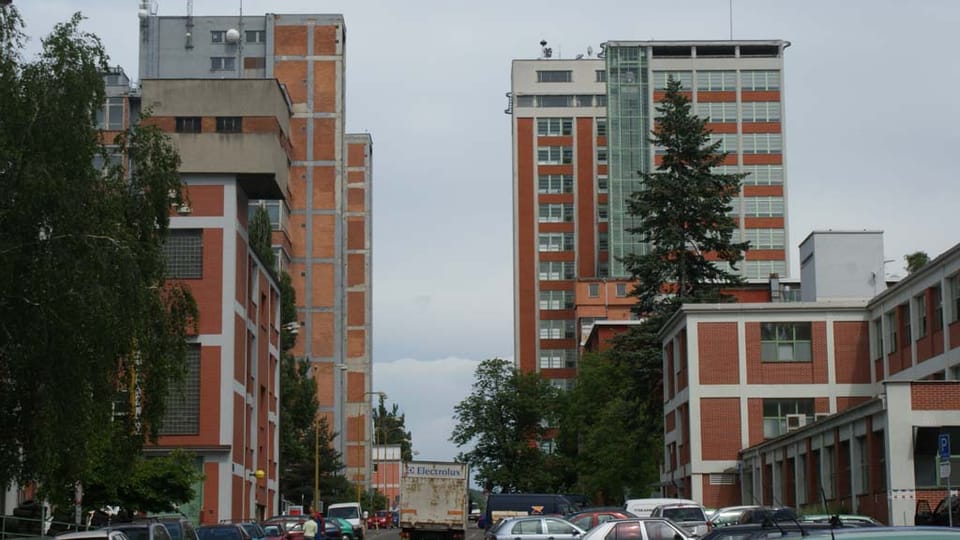
“Yes, but tangentially. When that was being set up, from the early ‘30s, he had more than enough to do in Hilversum, in the Netherlands.
“But he was brought in for various meetings, I’m told – there’s no documentation of this – and when he left Hilversum and came to the UK he was involved in first managing the development of what was already there in East Tilbury, but also going out into other parts of the UK to look at new sites.
READ ALSO
“So for example when my mother born, she was born in 1940 in Cambridge; that’s where the little family was.
“And I discovered recently that she spent eight months of her baby life in a place called Crosby, on what is now the West Cumbrian Coast.
“And they eventually kind of found their way to East Tilbury in 1940 or 1941, as mum, dad and two girls.”
This is something I never really thought about before, but were the staff at [Baťa in] East Tilbury mainly Czech, or were they British locals?
“A combination of both. Again, this is from family anecdotes [laughs], during the second world war there were a lot of expat Baťa staff passing through, I think would be the best way of putting it.
“They would arrive and then they stay and do things or go elsewhere. And going elsewhere was certainly what my grandfather expected to do.

“I’ve got some really interesting documents of his, like entry visas into Brazil in 1941 and Argentina in 1942 [laughs].
“No-one knows whether he actually went, but the logistics of that are quite mindboggling, if he did. I’ve no idea how he would have done that.
“But to answer your question, there were a lot of Czechs there, but also local people, but also people from other parts of Europe that were Baťa employees.
“I think like a lot of England that hasn’t been documented very well, a lot of England in those days had a lot of non-British people around, for various reasons. And East Tilbury was no exception – absolutely not.
"I have a fond memory of walking around East Tilbury with my grandmother in the 1970s. All her friends from the 1940s were old and they would chat in Moravian dialect.”
“I do have a really fond, madmemory of walking around East Tilbury with my grandmother in the 1970s. All her friends from the 1940s were retired and old and they would chat away in Moravian dialect for what seemed hours on end to me as an eight-year-old or whatever [laughs].
“It wasn’t until much later in my life that I realised that old people spoke English as well. The only people I encountered were basically speaking Czech [laughs]. I just thought that was a special language for old people [laughs].”
Did you speak Czech yourself? Or understand anyway?
“I understood words like ‘sakra!’ – that was deployed quite a lot by my grandmother – and occasionally ‘prosím’.
“But no, I was quite a boisterous child. I was much more interested in ruining my grandmother’s garden by ‘weeding’, or going off to play with people on the estate when we visited, riding bikes or whatever – I was never really around.”
When and why did you move to Prague?
“I moved to Prague in March 1993. I first arrived in September ’92, and at that time I was working for a British HR consulting firm and we were invited to come and pitch for work for a very large multinational.
“We pitched up and stayed… We couldn’t get a hotel, there was some big conference, and we stayed just by Jiřího z Poděbrad, in one of those apartment buildings.
“All my suits and ties moved to Prague in March or April, 1993.”
“We got the gig and I was the only available to sort of deliver it [laughs], so from then I was travelling backwards and forwards; I would stay in Prague for two weeks and go back for another two.
“Then we got more work and I moved over permanently. All my suits and ties moved to Prague in March or April, 1993. And I stayed there, like that, until March or April, 1999.
“My first apartment was in Vršovice. Then we moved to another place briefly, and then we moved to a village called Zvole, when our first child was born.”
It sounds like you had a rather different experience than many of the young wasters like me of 1990s Prague, in that you had to get up in the morning and go to work and be a responsible business person?
“Yes. That was pretty much me Monday to Friday. But I was on my Saturdays and Sundays, particularly Sundays; Saturdays were spent asleep really, but Sundays I would go just wandering.
“I would leave the apartment and go wandering around Vršovice, quite closely – it has changed a lot since those days – and make my way to Vinohrady and Žižkov, and obviously the centre.
“But yes, Monday to Friday was very definitely suit and tie and that kind of gig.”
You told me you got married at St. Joseph’s Church in Malá Strana and that you were the first couple married there since the 1930s. How did you get to do that?
“My wife’s British. Of Irish heritage, but born in the UK. She went to Sunday services in English at that church and got to know the priest.

“We were going to get married in London but for various reasons decided to get married in Prague.
“And the priest, Josef Pazderka, got himself licensed to perform wedding ceremonies and worked a lot with Maria to get the service together.
“And we didn’t know until we signed the register that there was a gap from 1930 – and then there’s our names [laughs].
“Basically it was closed down in the olden days and it was Father Josef who made it work.
“And it was a gorgeous day, absolutely fantastic day.”
When did you first get into Czech literature?
“When I was in Prague. I was a nine to five business guy, but I wanted to learn the language and for some strange reason decided to read books by Milan Kundera and others in translation.
“When I started trying to do that in Czech that was a bit of revelation. That was rather hard, so I learned a lot of grammar and vocab reading newspapers.
READ ALSO
“I started off with Hospodářské noviny, which, my God, back in the day a sentence could last two or three paragraphs. But also things like Mladá fronta, which was a lot easier to digest [laughs]. So that kind of gave me the grounding.
“But it wasn’t really until I returned to the UK. I had a chip on my shoulder that I didn’t have a degree; I had started one but didn’t complete it, in the ‘80s.
“One day I just decided to do something about this. I phoned up the School of Slavonic and East European Studies and said [intense voice], My name’s Mike Tate, I’ve got science A levels but I speak a bit of Czech. I’d like to study Czech – am I just wasting my time?
“The lady at the other of the phone was quite calm and invited me into an open day.
“And it was once I started studying at SSEES that I got into Czech literature. I went there with the intention of studying history [laughs] and learning Czech as a language rather than as a literature, but I kind of got sucked into it while I was there.
“It was once I started studying at SSEES that I got into Czech literature.”
“It was such a privilege. I was taught by [legendary UK Bohemist and Slavic Studies expert] Robert Pynsent – you just can’t describe that in any other way than as a privilege.
“Also I got to know [acclaimed Czech to English translator and academic] David Short rather well. We spent a lot of time together.
“Also you’ve got to bear in mind that most of the time it was just me in those lessons, so there was no hiding.
“And yes, I really treasure those memories, I really treasure that time.”
What led you then, I guess a few years later, to start up Jantar Publishing?
“It was entirely as a way to thank David Short for his patience. In my final year he gave me a dual-language text called Andělíčkářka, or The Angel Maker.
“In his view it solved all the major grammatical and syntactical challenges of translating English into Czech. And I just thought it was an amazing text. It was really, really compelling.

“And I’d met one of his former students, who ran a book distribution company, and together we produced this small book as a gift; I was going to give it to him.
“He had to know of course, and one thing led to another and we ended up starting a company and finding another text, which was Prague, I See a City by Daniela Hodrová.
“Then we started getting into copyright and translators.
“The idea at the beginning was that it was just going to be a gift – and then it was fairly clear that there was an interest beyond the SSEES population in our books.
“And we kind of just carried on. There have been several bumps in the road, to say the least [laughs], but it started off as a gift.”
I think the whole venture is a gift to Czech literature, especially when I know you have a demanding day job. Where do you find the energy and the motivation to keep running this publishing company, which must take up quite a bit of your time?
“It does take quite a bit of time. The short answer is I really don’t know.
“I am very passionate about it, which helps.
“I’m constantly engaged in conversations with really bright human beings, whether they’re authors, translators, agents, reviewers, whatever.”
“But it’s a really interesting thing to do. I’m constantly engaged in conversations with really, really engaged and bright human beings, whether they’re authors, translators, agents, reviewers, whatever.
“It’s constant and it’s really become part of my life.
“So it’s not a question of finding the energy, the energy’s there. It does get exhausting sometimes, but I just stop and have a sleep.
“That’s the secret of the success, I suppose [laughs].”
What have been some of your biggest sellers? I presume that the [Jaroslav] Rudiš book Winterberg’s Last Journey, which came out last year, must have sold relatively a lot?
“Yes. That was a bit of an experiment. You’re absolutely right, we sold out the first print run in four months, but it also opened up other interesting opportunities.
“It was really easy to find bookshops that wanted to stock it. It was really easy to find reviewers who wanted to review it.

“And this might be the wrong thing to say here, but I think it’s entirely because it was translated from German, which is one of the expected languages that literary translations appear from.
“We got a review in The Spectator, for goodness sakes, and it was a really, really positive one. It appeared in The Irish Times, it appeared in The London Magazine, it appeared in the TLS, it appeared on some fairly big blogs.
“But that actually isn’t our biggest seller, though. I think at the moment that would be number three, in total, though I didn’t prepare for this question [laughs].
“But Kytice is easily our biggest seller. And it just continues to confound me.
“That was the third book we ever published. That got a review in the TLS. I had nothing to do with that – it just appeared.
“Kytice is easily our biggest seller. And it just continues to confound me.”
“And then [UK author] Helen Oyeyemi described it in very glowing terms in a Q&A for The New York Times.
“There was a really weird few weeks where I was getting emails with screenshots of the bestselling poetry books on Amazon.com; it was, like, 41 or 43, depending on whatever day the screenshot was taken, and people were saying, Congratulations, how did this happen?
“And I just didn’t know. I hadn’t a clue. It was several weeks later that I found out about that interview.”
Typically, how do you choose what to publish? Is it just a matter of taste? Or are you calculating what could be a reasonably decent seller?
“Yes. The company has evolved quite a lot. Though Czech-language source books are a significant part of our catalogue, they are by no means all of them.
“At the beginning it was very definitely what we could find, and very definitely personal taste.
“The books have to sell. It just can’t be a hobby – they’ve got to sell.”
“These days though this is a commercial organisation, it’s not just me. The books have to sell. It just can’t be a hobby – they’ve got to sell.
“I really want to make Jantar into something that’s bigger, and that has a lot to do with the texts selected, but also getting the financing right, getting the people together to look after the commercial side.
“The easy bit is choosing the text to translate and publish. The really hard bit is getting reviewers to review them, getting them in bookshops, getting them on websites to sell, managing our own website, keeping the books in print [laughs], and so on and so on.
“Yes, it’s very much a commercial thing now.”
Where would you like Jantar to be in, let’s say, 10 years from today?
“Actually, there has been a lot of discussion about this in recent months. There are a few private investors who want to invest in the company, and I’ve encouraged that a lot.
“Also it’s a very engaging business model. Books in translation have a couple of key things in their favour right now.

“The first one is that the sales growth of those books increases every year.
“The second is that the demographic is very interesting. People who read books in translation are in their 20s, 30s and early 40s, but also the percentage of male readers is significantly higher than with a ‘normal work of fiction’.
“Thirty-eight percent of the readers are male, against something like 12 percent for a regular bit of fiction. This is in English in the UK and the US.
“So that actually makes it quite a compelling proposition.
“There are also some very good benchmark publishers in the UK.
“Fitzcarraldo and Pushkin, who have been around for less time than Jantar, are getting books onto Booker long lists, shortlists – and even winning.
“They’ve expanded quite dramatically and they’re making millions of pounds.
“I’m sitting in the southern end of Lewisham and Fitzcarraldo is about a mile and a half away. And they’ve got a chunky staff and are pumping out 20, 30 titles a year.
“That’s where I would like Jantar to be in 10 years.”
And can you imagine giving up the day job and only being a publisher?
“I can certainly imagine that, but I think it’s better to call it a dream. It’s better to call it a dream.”