Kratom: Will local bans help reduce its use among young people?

The sale of kratom in the Czech Republic has been subject to stricter regulations for four months now. Although it can currently only be sold by licensed shops, it was previously available, for example, in shopping centers. Despite the new rules, however, the substance remains widespread among young people in primary and secondary schools. One solution that municipal authorities are beginning to adopt is banning the consumption of kratom in public spaces.
Kratom is a psychoactive substance derived from the plant Mitragyna speciosa, which grows mainly in Southeast Asia. It is exported to Europe and other Western countries in the form of a green to dark green powder. In small doses, kratom has stimulating effects similar to those of cocaine or methamphetamine, typically causing increased energy and euphoria. For this reason, it is particularly popular among high school students. In higher doses, however, kratom has sedative effects comparable to morphine or heroin.

According to experts, several percent of the adult population in the Czech Republic have experience with kratom, but its use is significantly higher among young people. A study by the Prague Centre for Social Services found that 13.8 percent of adolescents had used kratom in the past year, with six percent using it repeatedly.
“Withdrawal symptoms are quite severe, and hospitalization – at least short-term – is usually recommended.”
Explains addiction specialist Martin Svoboda from the Mental Health Centre. According to him, kratom can also be deceptive because its effects last only a few hours, leading users to repeat doses.
“You quickly find that you need more and more. The substance works for two to three hours at most, so you need another dose to stay ‘fresh’, and then you realize you can’t function without it after waking up.”

At the beginning of March, the Czech government considered a complete ban on kratom sales, but the prime minister ultimately withdrew the proposal. According to the health minister, the government wants to first evaluate how effective the regulation of sales through licensed shops has been. Addiction expert Pavel Kubů, chairman of the Scientific Council of the Institute for European Legislation, considers this the right decision.
“It is great that the prime minister and the government listened to experts and the public and are giving the new regulation of psychomodulatory substances time to show its effects – which we, who work in this field, are already seeing.”
According to Kubů, the greatest risks associated with kratom use are linked to long-term and regular consumption of high doses. He also points out the lack of quality control as a major issue.
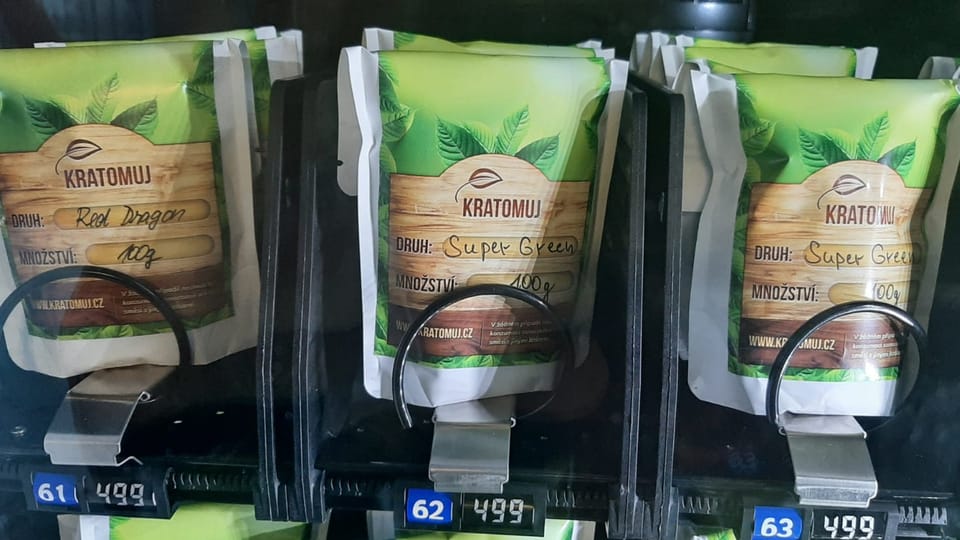
“A major risk – not only with kratom but also with other commonly available substances – is that products from the grey or illegal market undergo no quality control at all. They may be contaminated with substances even more toxic than the drug itself, such as heavy metals, herbicides, or pesticides resulting from poor production practices.”
Kratom use is particularly problematic among young people. At Palacký Primary School in Prostějov, staff have firsthand experience with its effects.
“We had a student who was clearly unable to participate in lessons and appeared very drowsy. At first, we were trying to determine whether he was simply unwell.”
Explains teacher and prevention specialist Jana Michalíková. Teachers later addressed the situation with the student’s parents. It was feedback from parents and teachers that led the city of Prostějov to expand its public alcohol consumption ordinance. The new rules are expected to also apply to psychoactive and psychomodulatory substances such as kratom.

“We are responding to feedback from parents because we believe this is a serious problem – not only nationwide, but already present in our city.”
Says Mayor František Jura (ANO). The amendment aims to ban consumption in specific areas – for example, within 200 meters of primary schools or near bus stops.
Similar regulations have already been introduced in the towns of Vysoké Mýto, Pacov, Blatná, and the municipality of Zámrsk, according to the Interior Ministry.
According to addiction expert and executive director of the Podané ruce clinic Viktor Mravčík, state regulation of kratom sales is a step in the right direction, and local restrictions on its consumption are also positive.
“Regulation alone will significantly improve the situation. And if municipalities add local measures, that would be the ideal solution.”
Related
-

New law aims for more liberal policy on psychoactive substances – but there’s a hitch
The government has moved to introduce a regulated sale of kratom and other psychoactive drugs considered low-risk. However the lack of regulations is causing problems.
-

Cotton-candy countdown: new vape rules target rising youth addiction
Electronic cigarettes with candy-flavored additives — such as cotton candy, marshmallow or donut — will soon disappear from Czech vape stores.