Inside Phonopolis, the striking new game from Czech studio Amanita Design
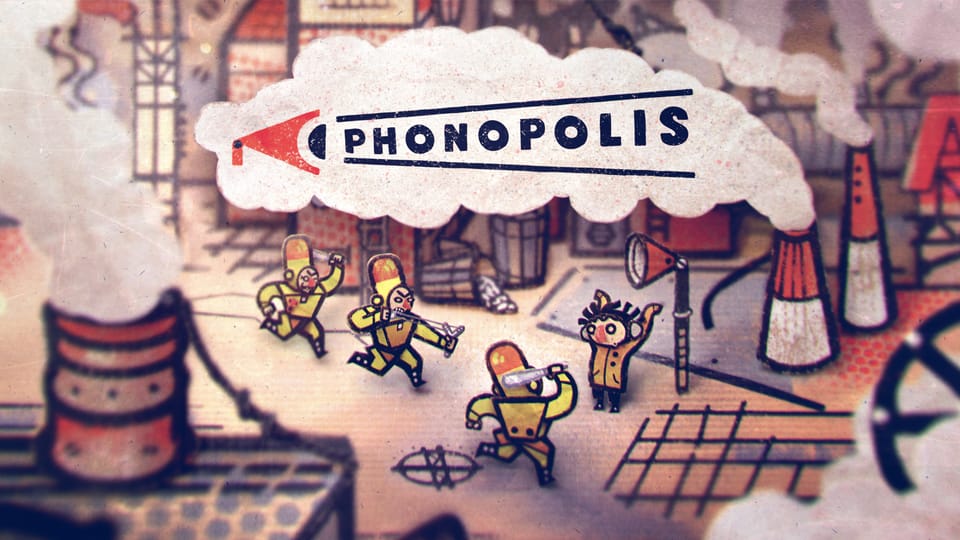
Award-winning Czech indie studio Amanita Design has unveiled its latest game, Phonopolis, a story-driven puzzle adventure set in a dystopian city built entirely from cardboard. More than a decade in the making, the game combines puzzle-solving gameplay with a distinctive hand-crafted visual style inspired by avant-garde art. What made the developers choose cardboard as the foundation of an entire game world? How do you turn stacks of paper models into a living digital city? And how did a project that took more than ten years to complete evolve along the way? I discussed these questions with Phonopolis producer Lukáš Kunce.
For listeners who haven't come across Phonopolis yet, could you briefly introduce the game, its story and the main characters?

"Yes, Phonopolis is basically an adventure game, a puzzle adventure game, like all of our titles. It's very much about the story, about the world, and solving some logical, or maybe not so logical, puzzles.
"Phonopolis specifically is about Felix, who is just a regular guy, a garbage man living in the city of Phonopolis. The city is very special because it's divided into three classes. At the bottom is the workers' quarter, in the middle is the bureaucratic quarter, and at the very top is the avant-garde quarter.

"And all of this city is controlled by the Leader, who is the main antagonist of the game. The Leader is basically a dictator, and he's built a system of loudspeakers all over the city. Through these loudspeakers he issues audio commands and controls the entire city. It's basically a mind-control scheme. He has this idea of creating a perfect society, but the execution is super strict, nobody has free will, and so on.
"We're not a studio that tries to follow gaming trends. We simply like doing things our own way, and fortunately that seems to have worked for the past twenty years or so."
"Felix, the main hero, is also under the control of the loudspeakers until one day he accidentally finds a pair of headphones and puts them on. For the first time he has his own thoughts and starts thinking for himself. He rediscovers his humanity and realizes that the Leader's perfect system may be not so perfect. He then goes on a journey to stop the Leader's plans to control the city forever."

As you said, the story explores themes such as freedom and the abuse of power. What made you want to explore that idea at this particular time? Were you trying to say something about the world we are actually living in today?

"I understand why many players will feel like it is very current in today's time, but the game was actually conceived about 13 years ago, so it's not directly intended to speak about current political issues.
"The truth is that it's always been like that in parts of the world. Today it's probably more visible because it's also happening in countries that are closer to us, let's say. And there's also the historical experience as well. Communism, which many of us experienced right here in our country, was probably the key and the major influence on the topic.”

The whole world of Phonopolis, including the buildings, the characters and even many of the visual effects, was first created from cardboard and only then digitized. Why did you decide to make the game this way?

"There were several reasons why we chose cardboard. One of them was that the team really wanted to take a break from working at computers and just work on something physical. The truth is, though, that this handcrafted part probably represents only a very small amount of the work. Most of the work still had to be done on the computer.
"Every scene and every level started with Eva Marková, who was the art director and concept artist of the game. She would draw the scene digitally in 2D and then hand the concept art over to Otto Dostál, one of the three main creators alongside Eva Marková and Petr Filipović.

"Otto would take the flat 2D concept art and translate it into 3D space very accurately and precisely, creating something similar to theatrical backdrops. He would texture them digitally and then print those textures. Using a plotter, he would cut them out as stickers, which would then be applied to large pieces of cardboard.
"That's when most of the handcrafted work would happen. We would paint them with acrylic paint, create masks, cut them out and do a lot of brushing and sanding with sandpaper to add another layer of texture and patina on top of the cardboard texture.

"Then we would photograph these handcrafted textures under simple lighting conditions and those photographs would be used as textures on the 3D models instead of the placeholder textures used before.
"And then there was a lot of work on the computer again because these photographed textures still had to be processed heavily in the 3D engine, applying lighting, materials and lots of additional processing. That's also one of the reasons why the game took such a long time to complete."

I also wanted talk about sound. Music has always played an important role in your games. But in Phonopolis, sound is at the very heart of the story. What role did music play in shaping the game? And what about the voice acting, which I believe is a first for Amanita?
"That's very true. Like with all Amanita games, both the music and the sound effects are just as important as the visuals. Every time we play and develop the game for a while without music, there's a huge difference once the music and sound effects are implemented. The game suddenly gets a completely new life.

"We were really delighted to work with Tomáš Dvořák, a.k.a. Floex, once again on the music. I think he did a fantastic job. He had to take a slightly different approach because the city of Phonopolis feels a bit like watching an old movie, it has this lo-fi quality to it.
"We tried to achieve that using some older devices. For example, he used an old cassette player and ran some of the audio files through it to add a specific texture that would be very difficult to create digitally.
"Then we had Matouš Godík working on the sound effects. He had previously worked with us on Creaks and Samorost 3. I think he also contributed a lot to bringing Phonopolis to life.
"As for the voice acting, just like you said, it's the very first time we've had comprehensible dialogue and complete sentences in one of our games. Previous games only featured gibberish, sometimes with a little Czech mixed in, but there was no actual dialogue and no subtitles. This time the team felt the story needed to be told more accurately because of its more serious themes, so we decided to use voice acting.

"A funny coincidence is that the narration was voiced by Joe Acheson from Great Britain. We had previously worked with him on the music for Creaks. He's better known as Hidden Orchestra and is probably familiar to many Czech music listeners because he performs here quite often.

"It was a great collaboration because Joe immediately understood the intended tone of the narrator. We told him it should sound like a grandfather telling a story to his grandchildren by the fireplace. Even though the game's themes are quite serious, we wanted to keep the tone more playful and light-hearted than some of its influences, such as Orwell's 1984 or Zamyatin's We. It was always meant to feel more like a fairy tale."
As you said, Phonopolis is an adventure and puzzle game. What opportunities did the cardboard world give you when it came to designing these puzzles?
"I would say it really helped support the feeling of tangibility that we try to achieve in all of our games. Because it's actually made from physical material, it feels inviting. Players want to touch the objects and interact with them.

"One of the main ideas behind the puzzle design wasn't just to create puzzles, but rather interactive toys or toy boxes that would remind players of childhood toys they simply want to tinker with. So I would say tangibility was one of the main benefits of using physical materials.
"One of the main ideas behind the puzzle design wasn't just to create puzzles, but rather interactive toys, so I would say tangibility was one of the main benefits of using physical materials."
"And I think interactivity was also one of the reasons we chose this production method. Back when the project was first conceived around 2013, the original idea was a little different. We considered building real-life models and scenes and then photographing them, using those photos almost like sequences.
"That approach would still have looked great and would have had a unique visual quality, but there would have been strict limits in terms of interactivity. When you're working only with photographs, the possibilities are much more limited. Using 3D models textured with handcrafted materials gave us much more freedom to create a world full of touchable and interactive elements."

You said the original idea came 13 years ago. Does that mean you've actually been working on this game all those years, or was it more of an on-and-off project?
"Pretty much. The project was conceived in 2013 by three former classmates from the animation programme at Zlín University, Petr Filipović, Eva Marková and Otto Dostal. For a while they worked on the game under a different studio, but that studio wasn't willing to finance the entire development. So they started looking for another studio where they could continue the project.

"They got in touch with Jakub Dvorský, our studio founder and director. Jakub really liked the vision, the creative direction and the art style, and they agreed to continue the project together. That was obviously great for the team because Jakub helped them find many collaborators and gave them the opportunity to work with people like Tomáš Dvořák and Matouš Godík, who really helped elevate the game to another level.
"But basically, yes, the game was worked on continuously for more than ten years."

When you create your games, are you thinking about your potential audience? I know Amanita's games are particularly popular among families and children.
"Yeah, absolutely. It's a balancing act because first and foremost we want to make games that we ourselves would want to play. Maybe that's a bit selfish, but at the same time you can't ignore the fact that you want people to enjoy them as well.

"We're not a studio that tries to follow gaming trends or anything like that. We simply like doing things our own way, and fortunately that seems to have worked for the past twenty years or so.
"For example, we don't spend much time worrying about marketing analysis or targeting a very specific audience. Instead, we try to make games that can be enjoyed by everyone – small children, teenagers, adults or seniors. The games are also very accessible in terms of controls. You don't need to be a skilled gamer to enjoy them. In a way, they're more like highly interactive animated films.
"I understand why many players will feel like it is very current in today's time, but the game was actually conceived about 13 years ago, so it's not directly intended to speak about current political issues."
"The nicest feedback we get is often from people who play our games together with their children. At events it's often the child who gets excited about the game first, and then the parent joins in and they enjoy it together. It's always really nice to see."

Are you already working on a new project?
"Yes. For the past decade or so we've been operating with several independent teams at Amanita. Counting Phonopolis, that would be three teams at the moment, or three and a half, actually.

"Apart from Phonopolis, there are two other games currently in development. One is led by Jakub Dvorský, who previously created the Samorost series, Machinarium and Pilgrims.
"The other team is led by Jaromír Plachý, who created Botanicula, Chuchel and Happy Game.

"And then there's the half-team, which is basically Radim Jurda. He's been with us for a long time and was the creator, designer and artist behind Creaks.
"Recently he's been working on a physical board game based on the world of Pilgrims. It's called Pilgrims: Curious Adventures. He's been developing it mostly on his own, while also collaborating with the Czech publisher Pink Troubadour, which has been helping with the design, publishing and distribution."
Do you already know when this board game will be released?

"We soft-launched it last autumn, around September or October. We didn't manufacture that many copies and it sold out within about a month.
"But it's coming back very soon. At the beginning of June it will be available again. Originally we only had an English version, but now it will be available in many regions and language versions, including Czech.
"So yes, it's coming very soon."
Related
-

Infinite Universes
Mafia, Arma and Chuchel are just some of the Czech video games that have conquered the world. Take a look behind the scenes of the Czech gaming industry in our new series.