Developer Serge Borenstein: The pilot said, It’s nothing, it’s Karlín
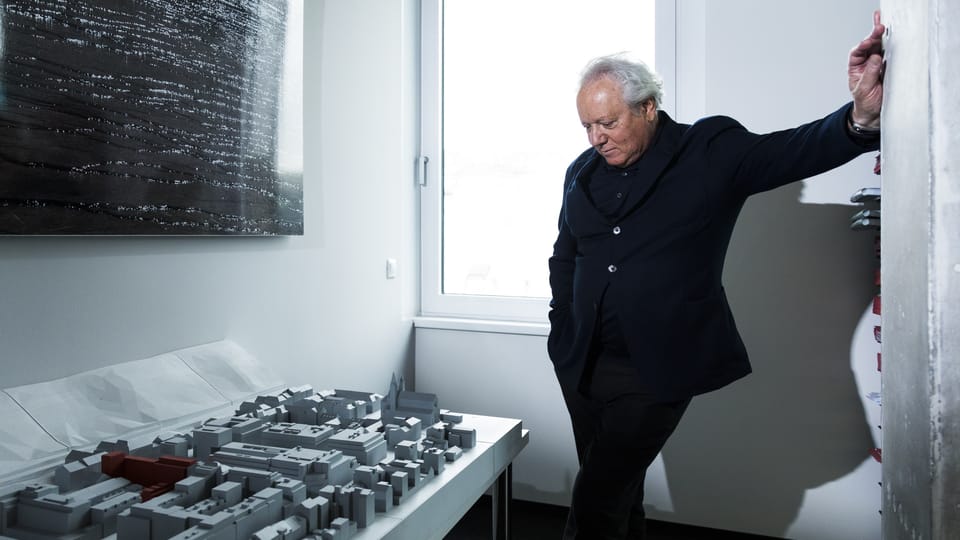
No foreigner can have had such an impact on Prague in the modern era as Serge Borenstein. Indeed in three and a half decades, the Belgian-born developer has been behind new constructions totalling a remarkable half a million square metres in and around the capital. His most notable projects have been in Karlín, a district he has almost single-handedly transformed with a series of gleaming office buildings. And it was at Borenstein’s offices there that we spoke recently.

You first came around the time of the revolution to do a property deal for Belgium. Then you decided to move to Prague. What was it that drew you to Prague, or made you think, I wouldn’t mind trying to live here?
“As you said, I came here for business reasons. But the atmosphere in the country at that time was absolutely amazing and unique.
“I said, I want to be part of it.
“And it also reminded me of the 1960s, when there were the famous student revolutions in France and Belgium, mainly in France, and I said, OK, let’s double that experience.”
You first were in the billboard business but then you got into real estate.
“I first was in the billboard business because you couldn’t do real estate business in the country.
“It reminded me of the 1960s, when there were famous student revolutions in France and Belgium.”
“Remember that in the beginning the government of Václav Havel organised restitution, and then there was privatisation.
“And we, developers like me, had to wait for the end of those processes.
“So I started a billboard network. That allowed me as well to get to know cities and the country – and I really just fell in love with the country.”
How did doing business here compare to working in real estate in Belgium before you came here?
“There were a lot of things to create here which were already done in a lot of countries in Europe.
“Here I had the possibility to transform some district, like I did with Karlín. That was not possible in Western European capital cities, because we had 40 or 50 years after the war. That was the big difference.”

You became known as Mr. Karlín for all you did to transform this district, where we are right now. What was your first experience of this part of Prague?
“I was, as I often say, in the right place at the right moment. That’s all.
“And I had an opportunity to buy this industrial complex in Karlín. It was a few different factories owned by the same company, and that gave me the space to develop a district, like Karlín.”
But isn’t it the case that you first saw it from the air?
“The government of Václav Havel organised restitution, and then there was privatisation. Developers like me had to wait for the end of those processes.”
“Yes, I discovered Karlín coming back from Karlovy Vary. We passed above Prague – I don’t even know if it was completely legal – and suddenly I asked the pilot, What is that area close to the centre that looks completely industrial and empty?
“He said, Oh, there’s nothing there – it’s nothing, it’s Karlín [laughs].
“The day after I was discovering Karlín and I said, That’s the place I want to develop.”
I know you started here in the ‘90s. Then of course in 2002 catastrophic floods hit Prague and this part of the city in particular was under water. But was that ultimately a kind of blessing for you, that the district had a chance to really come back strongly, in a new form?
“It was definitely a blessing, because Karlín was the object of all the attention from the city, because it was probably, at least in Prague, the most hit area.
“And Prague wanted to decide to create a large retention area for water, indeed to erase Karlín from the map, more or less.

“Of course they didn’t do it, but there was a question about it.
“So I strongly fought against that – and that also made me more known to the population, because I created a kind of committee defending Karlín and things like that.
“We fought and in the end we won. We won.
“And to finish your question, it was a kind of blessing for me, because the day that they decided they wouldn’t make a retention area out of Karlín, now they decided to invest in it.
“I had the possibility to transform a district, like I did with Karlín. That was not possible in Western Europe.”
“The investment was into infrastructure – all of the infrastructure of the district was destroyed by the flood – and also an anti-flood wall.”
So the fact that they put in this new flood defence system kind of guaranteed the future safety of this part of the city.
“Absolutely. That was a blessing for me. That was the best thing that could happen.
“Suddenly that area was full of brand new infrastructure; I’m talking about sewage system, cabling.
“And I just had to build new buildings and I found an area close to the centre with a fantastic infrastructure.”
Of all the buildings that you have constructed in this district, is there one that you’re most proud of?
“Yes, always the last one [laughs]. The last one I built is always the one. Of course I love them all.

“I’m quite fond of a building called Corso Karlín, which is a transformation of an old factory into a modern office building.
“But we kept more or less all of the architecture of that old factory and we put a modern building inside.
“It was an architectural challenge, it was very difficult to achieve, but the building is there. It’s a monument for me.”
Also what you did, which I think is a great gift to the whole Prague, is you built the complex where the Forum Karlín music venue is. A modern venue was so needed in Prague.
“Yes. By the way [laughs] I am trying to buy back the building today.
“But there is a lot of competition and whoever will buy it will have a fantastic building.”
Maybe this question is naive, but I know that at one point you owned 60 hectares in Karlín and you built on 250,000 square metres. How come you didn’t build more here?
“We indeed developed much more than 250,000 square metres. We got permitting for much more, but we couldn’t build, physically, much more, because there are seven days in a week, 30 days in a month.
“So we decided to sell a part of the permits to other developers. And thank God we did, because if we had to build it by ourselves it would have taken another 20 years.”

Generally speaking, as somebody who has been involved in the transformation of Prague, how do you view how the city has developed since, say, 1990, in terms of new buildings and developments?
“You will be disappointed to hear, but as well as being happy with what has been done, I can confirm that much more could have been done. It’s sad.
“I travel quite a lot in Eastern countries, in Poland, in Romania and places like that, and I recommend a lot of Czechs to go and see what’s happening there, because we are late compared to those guys.
“The average time to get a building permit is seven years. It’s absolutely crazy.”
“We are late and it’s certainly not either my mistake or the mistake of other Czech developers but mainly of the authorities of Prague and of the country as well.”
What do they need to do better than what they’re doing now?
“Give building permits. The average time to get a building permit is seven years. It’s absolutely crazy.
“And in the last few years mainly the policy has been that it’s better not to move too much than to make mistakes in authorising and things like that.
“So there was simply a lack of enthusiasm, or I would say work, from the people responsible for development.

“And that’s also true for other cities as well.”
You don’t see any signs that this is improving? It stays in this kind of static situation?
“I’m going to make a lot of enemies, but you know it’s a tough life – I don’t see that moving now, really.”
What do you think are the best buildings that Prague has got since you arrived here, including yours perhaps, if you want to speak about those?
“I’m a big fan of developers called Penta. The owner is Mr. Dospiva.
“I think they really take care about what they are doing, they use good architects and they have good locations.
“I think he is a model to be followed in Prague.”
If I could ask you a bit about yourself, I know you sponsor arts events a lot – what’s your motivation for doing that?
“I myself am, I think, a kind of artist in what I’m doing in business. Maybe I should have been more of a traditional businessman, but I think I’m an artist.
“Maybe I should have been more of a traditional businessman, but I think I’m an artist.”
“You probably know that I love music. I practice guitar every day.
“So I’m naturally attracted to the arts. I dance. And now I’ve launched a new life as a film producer.”
The fact that you started to learn guitar at the age of 60 is very inspirational to me. How difficult is it? If I was to start playing guitar now, at my age, how hard is it to go from zero to actually being able to play?
“I will surprise you maybe – it’s not difficult.
“It’s not difficult, but you must be regular and you have to be disciplined. That’s the secret.

“And you have to play every day. Not six hours on Monday and one hour on Thursday and nothing during the week. No, you have to play every day 10, 15 minutes – that’s the secret.
“If you do that during a year, if you do that during six months, you will do that and you will see yourself progressing.”
You mentioned film production. You were one of the producers of the movie Úsvit, or We Were Never Modern. How did you find that, and will you produce more?
“Fantastic. And I was a co-producer [of Úsvit] – I was not the only one.
“From that moment I have produced another two documentaries. One I really advise you to see, it’s called Documerica – it’s a fantastic documentary.
“Another one that I didn’t produce but I’m involved in the process of showing the documentary to the world is called Mr. Nobody Against Putin.
“And I’m the main producer of a big movie in France now.
“It’s called Hero and it’s about the life of a night watchman at the Louvre during the war who saves millions in art pieces by putting them on a truck and hiding them for five years – and comes back after five years with all those pieces and asking the director if he can have his job as a night watchman back.”
You’ve been here for 35 years or so, living among the Czechs. How would you describe the Czech people?
“It’s a small country that was isolated already by the language.
“But I’m always so surprised – I travel all over the world – to meet Czechs abroad.
“That’s not a description, but first of all I want to say that they travel a lot.
“They are very good businessmen, especially in all technologies. And not just cars, they create a lot of technologies, such as pumps.
“I’ve launched a new life as a film producer.”
“They are good entrepreneurs – and they are educated people. They like knowing about history, the history of their country, the history of Europe.
“When I go to America and say I come from Prague, they say, Oh yes, we know, Yugoslavia is a nice country.
“But that will never happen with a Czech [laughs]; they would not say that Washington is a nice place in Canada.
“So if I have to describe them [laughs], that’s my way to describe Czech people.”