“A slice of Edinburgh”: The 24th Prague Fringe Festival kicks off its rich programme of performances
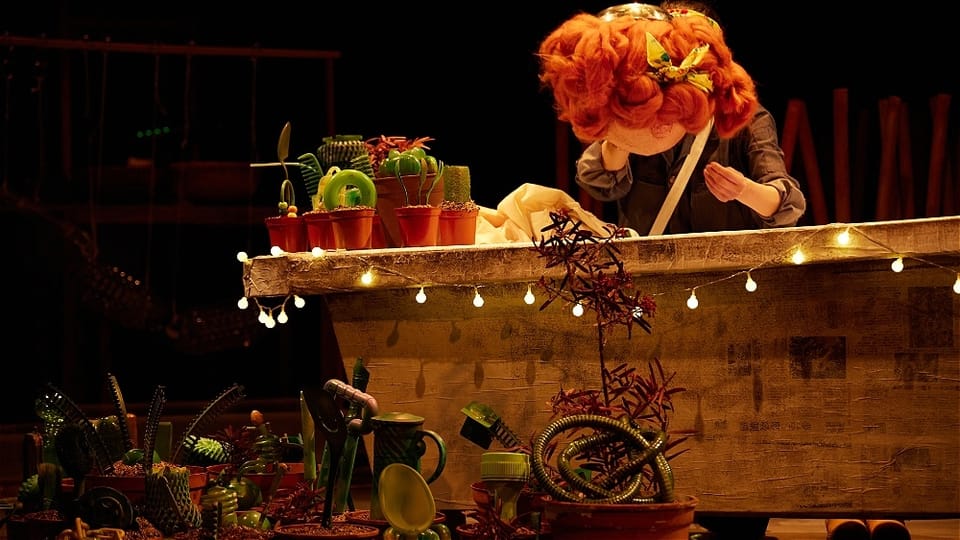
Returning for its 24th edition, the Prague Fringe Festival offers the Czech capital a cornucopia of English-language comedy and theatre. Ahead of the programme’s start on May 26th, Danny Bate met with its founder and director, Steve Gove, to find out what’s in store this year, how the Prague Fringe works, and how it successfully recreates the spirit of the Edinburgh original.
A brief history of the Prague Fringe
When did you have the original idea for the Prague Fringe?
“It came to me in a bar in Edinburgh in 2000, during the Edinburgh Fringe. I'd been living in Prague for a few years before that, and I thought, ‘why is there not more English language theatre here?’ It was a bit of frustration, to do with the fact that I couldn't understand Czech enough, and the question of whether it would work to bring English-language theatre here. I said to a group of friends, ‘right I'm going to start a Fringe in Prague, do you want to be part of it all?’ That was how it all started.

“We had a press call the following year in Edinburgh, at the Pivo Café (which doesn't exist anymore, sadly). Radio Scotland and a few other media turned up to the press conference, and we announced that in 2002 there would be the first ever Prague Fringe Festival.
“At that time it was one of only thirty Fringes. There were not that many Fringes in the world then. Edinburgh was the oldest, and still the biggest arts event in the world as it was then. But there are now something around three hundred ‘Fringes’, so it's become a bit of a thing.”
How much would you say that you have replicated the spirit of the original Fringe in Edinburgh?
“Very much so! A dear old friend called Jim Haynes founded the Traverse Theatre and was one of the early movers and shakers at the Fringe Festival in Edinburgh, right at the very beginning in the 1950s. When he came here, he said, ‘Prague, it's like Edinburgh in the 60s: intimate, fun and friendly’. I loved that. That is exactly it.

“If you know Edinburgh, it’s a great event, but it’s very big, you can get lost, and you don't know what to go and see. The idea of the Prague Fringe was to take a slice of Edinburgh and plant it here. We would make all the venues close together, so that you can easily get from place to place, keep the ticket prices down, and open the shows in little intimate venues. So, it's very much like how the Edinburgh Fringe was back in the day, when I started going there in the mid 90s.”
How the Prague Fringe works
In terms of geography, the core of the Fringe is Malá Strana, right?
“It’s all happening in Malá Strana. Where we're standing right now is the Museum of Alchemists, which is a little bit further up the hill towards the castle. All the other venues are actually within a minute or two's walk from here and each other. So we're playing in Malostranská Beseda, Divadlo Inspiráce, part of the Performing Arts School, Studio Rubín, Metro Comedy Club, and the Café Club Míšeňská.

“This makes getting from venue to venue easy. The programme is designed so that at the end of every show there's a whole range of shows that you can go and see starting within 15-30 minutes of your exiting a theatre. This keeps us all moving till the early hours of the morning.”
So audiences have time to make it to the next one?
“Yes, and as I said, we're trying to keep the cost down, so tickets are only about 300 crowns each, and you can get discounts too. The idea is that you'd go and see two or three shows in an evening, rather than a typical visit to the theatre. For that, you go and see something, and as you're leaving you say, ‘well that was great’, and then you go home. But for the Fringe, you're supposed to just jump in and take bites of it as you go through your evening, and at the end of it go, ‘what just happened to me? I was crying, I was laughing, I was completely bamboozled, I had no clue what that show was about, but what an experience, and I'm desperate to come back tomorrow for the whole thing again’.”

Putting together a festival
How difficult is it to attract English-speaking acts and performers to Prague?
“It's pretty easy now that we've been going for all these years. This will be our twenty-fourth year this year. But even at the very beginning it was surprisingly easy. I think when we started to spread the word about the Prague Fringe, people had heard of it, even though it hadn't even happened yet. It just seemed right, and the Fringe phenomenon was starting to become a thing, with people travelling to Australia, to Brighton as well, as well as Edinburgh and all the Canadian Fringes.

“So it didn't seem to be a stumbling block. Certainly back in the day, it was super cheap here. It was more expensive to get here, but once you were here it was cheap for hotels and accommodation, and the beers were cheap. Now it's a bit more expensive, while flights are cheaper. But certainly it was never a stumbling block, and people would think, ‘wow, yeah, Prague, I've always wanted to go there’. Even now, even if people have been, they want to come and perform at the Prague Fringe, which is an event that's now known.”
And so when does the planning start for each edition of the Fringe? When did you start planning this one?
“Well, I'm already talking about the next one with colleagues! As the event unfolds, we're always coming up with ideas, we make notes somewhere in the back of our heads, and then we shave an informal get-together. Then afterwards, and after the festival, we say, ‘right, let's do this, this, and this’.

“Personally, I will be booking the venues for next year already as soon as this is over, and getting the marketing campaign set up in advance before the summer. Then I'll go to Edinburgh, see shows, and spread the word. Then in the autumn I start to go to other Fringes. I've been going recently to the Fringes in Sicily and Milan, which has been great, so we've been attracting bits of Italian work over the last two or three years.
“It's a never-ending process, really, and we're a tiny team of one (me), most of the year, and with a number of people that help throughout the year on a very part-time basis. Then it builds to a slightly smaller team the month before, and then there's about fifty or sixty of us, including the volunteers who take your tickets on the door. So, it's an all-year planning process.”
Czeching your English
English-speakers in Prague are pretty well represented, and you could make many great audiences out of them alone. But you also want to reach out to Czechs and people who may not have English as their first language. How do you deal with the language barrier? How do you incorporate that into the Fringe?
“It was certainly difficult in the early days of the Fringe, but it wasn't that difficult to predict, when twenty years ago Czechs were already speaking beautiful English, and I thought would definitely understand some English live performances, that in ten, twenty years from now, everyone's going to be fluent and speaking English perfectly.
“There are a lot of Czechs coming to our shows, and they look forward to it, because it's something a little bit different. There's tens and tens of nationalities who visit our festivals, so the majority of people are actually not native English speakers.

“We do have a peppering of non-verbal performances at the festival as well, and we have a section called Easy English, so the artists can indicate to us that perhaps it's largely non-verbal with a few words thrown here and there, or even more difficult English. It’s tagged so that you can jump in and see what's going on. You can jump in at the level that you feel comfortable with. There are, I would say, more non-native English speakers than native ones.
“However, when you come to the Fringe, you might think that everybody is British or American, but more often than not, half the people speaking English are actually also Czech, they're just embracing the English-language environment. Perhaps they’re English and married to someone who's Czech, or vice versa. But it's definitely a mixed bag of people that visit the festival.”
But to understand comedy, especially in the realm of stand-up, it's not just about knowing the sounds and the grammar of the language – you have to get the references as well. Do you find that comedians tailor their jokes to a non-country-specific audience?
“To a degree, that's true. I think it's a great place for artists to come and try out work as well, comedians particularly, because if they're keen to travel around Europe and take their work to other European cities, they've got to somehow try it out. It could just be diction or accent that makes the difference between people understanding and not understanding.

“There are certainly some shows that are much more British-centric. This year there's a one-man show, in which he plays the guitar and sings, about characters that he's met while working in English pubs. Now, that's obviously very British, and you're going to maybe not get all the innuendos. But by and large, I think things are pretty accessible for most people.”
The cutting edge of the Fringe
For this particular edition of the Fringe, what would you say is distinctive this year?
“There's one aspect of the festival that I'm loving and that we've been building over the last couple of years, which is the inclusion of artists from India and from other far-flung parts of the world. Last year we had artists from Taiwan. They came to perform and were supported by the Taipei government. Also this year we've got a group of artists coming with a children's show, which I picked up at the Edinburgh Festival last year, also from Taiwan.

“Within the Fringe, we've got a festival of India: four shows, all distinctly different, from storytelling, to a show about love and friendship, to a bizarre show about the madness of this world that we live in. That's all under the umbrella of Festival of India, which is a really exciting addition to the programme this year.
“I'm super excited about the comedy section. All of the comedy this year will be in the Metro Comedy Club, which has recently moved over to Malá Strana. We've got Mark Watson coming. I'm really excited about that. It's quite funny, because I've known him probably for ten or twenty years, since when he was probably starting his career. When I tell people that Mark Watson's coming, they say it’s amazing, and I’m like, ‘oh, yeah, it's a guy that I've known for years from the festivals’.
“I’ve asked him how many years it's been since he’s played in a venue for fifty people. But he’s into it, really up for it, because he plays in big halls now, and he's on television a lot.

“There are a lot of artists who come back. There was an artist who I signed up for the Fringe last year, Christopher Sainton-Clarke, who had a show called A Year and a Day. It was a really intriguing premise: this character fell asleep, and then when he woke up, a year and a day had passed. So his life goes incredibly quickly, but normal life continues, and it shows all of the sort of interesting dynamics of that. And Christopher came and was so excited that he got accepted to the Fringe, and he got sold-out houses.
“At the end of the festival. He said to me that he was going to give this show up because it wasn't being well received at home. I said, ‘okay, you have a year and a day to write another show’. He's coming back, and premiering a show which he's been working on all year since. So a lot of beautiful, magical things happen at the Fringe.
“Pip Utton, who's in his late 60s, has been a friend of mine for many years. He comes to the Fringe every year. This year he's bringing his show Lear. He's been Churchill, he's been Thatcher, he's been a whole number of different characters, but this year he's bringing King Lear. He's an absolute crowd pleaser. He sells out all of his shows, and I'm super excited by that as well. Again, that's a premiere.
“So we've built all these beautiful relationships with both young upcoming artists and older artists who are still creating new work. I'm really proud about that, it excites me a lot.”
The 24th Prague Fringe Festival runs from May 26th to 31st, and all the information about the event and its programme can be found here: https://www.praguefringe.com/






